
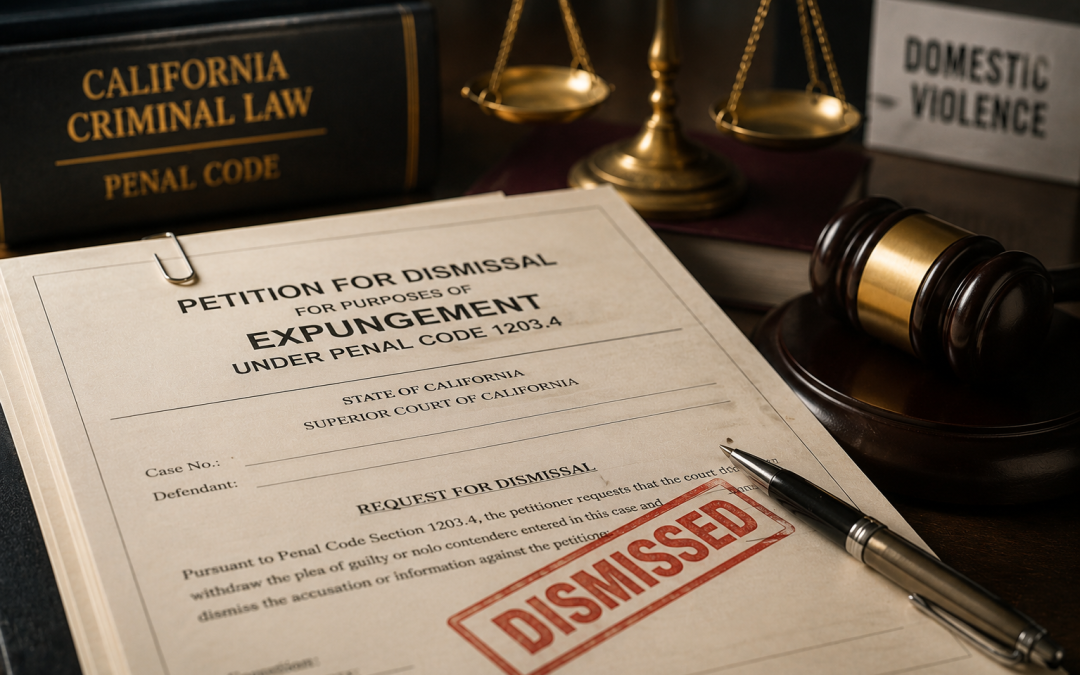
A California domestic violence conviction may qualify for dismissal, commonly called expungement, after the person completes probation or satisfies another record-clearing law. However, the process does not erase the conviction or remove every consequence.
The correct procedure depends on whether the case ended in a conviction, what sentence the court imposed, and whether the person currently faces another criminal case.
Expungement vs. Dismissal in California
California does not offer a traditional expungement that destroys every record of a conviction. Instead, Penal Code Section 1203.4 allows an eligible person to withdraw a guilty or no-contest plea, or set aside a guilty verdict, before the court dismisses the case.
The arrest, court case, and dismissal may still appear on criminal history records. The record should show that the court dismissed the conviction rather than suggesting the case never existed.
Which Domestic Violence Convictions May Qualify?
Domestic violence describes several offenses rather than one specific charge. Common California convictions include misdemeanor domestic battery under Penal Code Section 243(e)(1) and corporal injury to a spouse or cohabitant under Penal Code Section 273.5.
A misdemeanor domestic battery conviction often qualifies for dismissal after successful completion of probation. Her Lawyer’s guide to domestic battery in California explains the offense and its possible consequences.
A felony conviction may also qualify in some cases. Eligibility depends on the sentence, whether the offense can be reduced to a misdemeanor, and which record-clearing statute applies.
Eligibility After Probation
A person who received probation may seek relief under Penal Code Section 1203.4 after completing all probation conditions or receiving early discharge. At the time of the petition, the person generally cannot be serving another sentence, on probation for another offense, or facing a new criminal charge.
When a person violated probation or did not complete every condition, the judge may still grant relief in the interests of justice. However, the decision becomes discretionary rather than automatic.
California law also states that unpaid restitution or a restitution fine alone cannot justify denial of a petition under Section 1203.4.
Cases Without Probation
A person convicted of a misdemeanor without probation may qualify under Penal Code Section 1203.4a. The person generally must wait at least one year after judgment, complete the sentence, and avoid new criminal charges.
A judge may consider the person’s conduct since the conviction and whether granting dismissal serves the interests of justice.
Felony and Prison Sentences
Current California law also provides a possible path for some felony convictions involving county jail or state prison sentences. Under Penal Code Section 1203.41, an eligible person may petition after completing the sentence and the required waiting period.
The court usually considers whether dismissal would serve the interests of justice. Different waiting periods apply depending on whether the sentence included mandatory supervision, county jail, or state prison.
Some domestic violence felonies qualify as “wobblers,” meaning California law permits misdemeanor or felony treatment. In certain cases, a person may request a felony reduction under Penal Code Section 17(b) together with or before seeking dismissal.
How to Request a Dismissal
The petition usually goes to the same superior court that handled the original criminal case. County procedures and filing requirements may vary.
The process commonly includes:
- Obtain the case number, conviction statute, sentence, and probation records.
- Complete the Petition for Dismissal, Form CR-180.
- Prepare the Order for Dismissal, Form CR-181.
- File the forms and any required supporting declaration with the court.
- Provide the prosecutor with the required notice.
- Attend a hearing if the prosecutor objects or the court schedules one.
Penal Code Sections 1203.4 and 1203.41 require at least 15 days’ notice to the prosecuting attorney before the court grants relief.
What Does a Dismissal Accomplish?
A successful petition changes the court record to show that the conviction was dismissed. This result may reduce the conviction’s impact on private employment, housing, professional opportunities, and background checks.
However, employers or licensing agencies may still access the record in certain situations. Some applications for public office, government licensing, and California State Lottery contracts still require disclosure.
A dismissal also does not stop prosecutors from using the prior conviction in a later criminal case. California law allows the prior offense to retain the same effect in future prosecutions.
Consequences That May Remain
A domestic violence dismissal does not automatically restore every right or terminate every court order.
Firearm restrictions
Penal Code Section 1203.4 specifically states that dismissal does not restore firearm rights. State and federal restrictions may continue even after the court dismisses the conviction.
Criminal protective orders
An unexpired criminal protective order remains enforceable after dismissal. The order continues until its expiration date or until the court modifies or terminates it. Her Lawyer’s article on domestic violence restraining orders in California discusses related protection orders.
Immigration consequences
A California dismissal may not eliminate federal immigration consequences. USCIS treats many expunged convictions as continuing convictions for immigration purposes because the dismissal does not remove the underlying finding of guilt.
Family court concerns
Dismissal of a criminal conviction does not automatically erase the underlying incident from custody, visitation, or restraining-order proceedings. Family courts may still consider admissible evidence involving domestic violence when making safety-related decisions.
What If the Charge Did Not Result in a Conviction?
A person who was arrested but never convicted usually does not need an expungement. Instead, California’s arrest-record sealing laws may provide a more appropriate remedy.
Record sealing may apply when prosecutors never filed charges, the court dismissed the case, the person received an acquittal, or another qualifying resolution occurred. The rules and forms differ from a petition to dismiss a conviction.
FAQs About Domestic Violence Expungement
Does dismissal completely erase a domestic violence conviction?
No. California dismissal changes the disposition of the case but does not destroy the court and arrest records. The record may still appear with a notation showing the conviction was dismissed.
Can a misdemeanor domestic battery conviction qualify?
Many misdemeanor domestic battery convictions may qualify after probation or the sentence has been completed. Eligibility depends on the case history, probation compliance, and any pending criminal matters.
Can a felony domestic violence conviction be dismissed?
Some felony convictions may qualify under Penal Code Sections 1203.4 or 1203.41. A qualifying wobbler may also be eligible for reduction to a misdemeanor under Penal Code Section 17(b).
Does dismissal restore firearm rights?
No. A California petition for dismissal does not automatically restore firearm rights. Separate state and federal restrictions may continue.
Discuss California Record-Clearing Options
Domestic violence record relief depends on the exact conviction, sentence, probation history, protective orders, and any immigration or firearm consequences. Reviewing the original court file can help identify the correct petition and realistic effect of dismissal.
Contact Her Lawyer to request a consultation about dismissing a California domestic violence conviction or addressing related post-conviction concerns.