
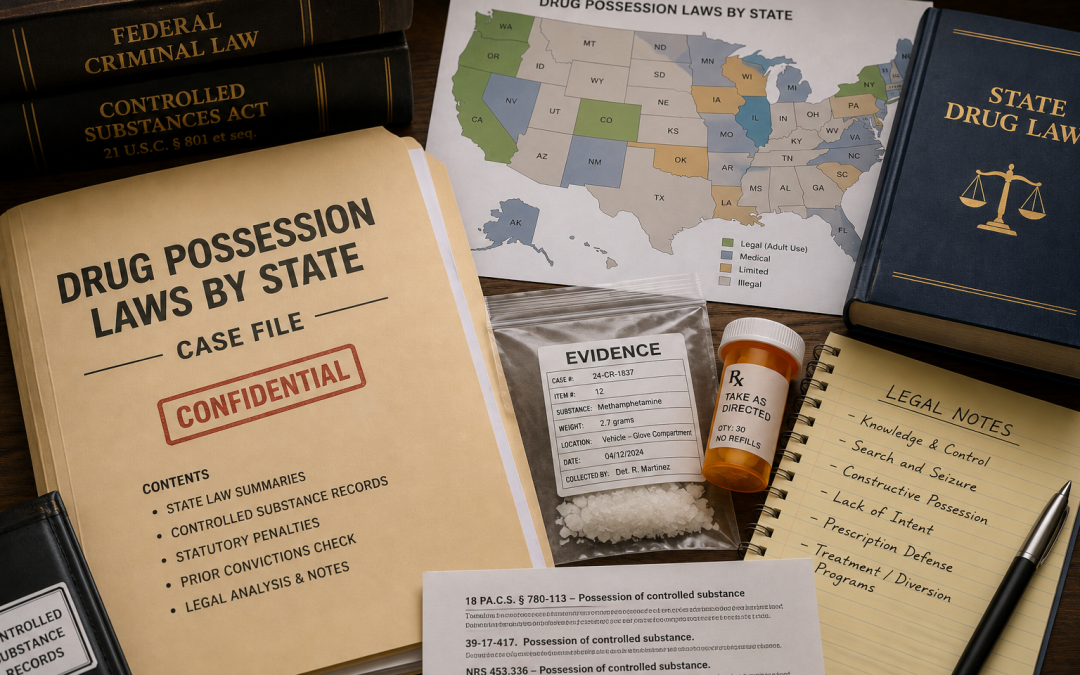
Drug possession laws by state vary widely. Some states treat simple possession as a misdemeanor for many substances. Others charge possession of certain drugs as a felony, even for small amounts.
The charge depends on the substance, drug schedule, quantity, prior convictions, intent to sell, location, and whether the case involves cannabis, prescription medication, or a harder controlled substance.
What Is Drug Possession?
Drug possession means having control over a controlled substance without legal authorization. Possession may be actual or constructive.
Actual possession means the substance is physically on the person. Constructive possession means the person has control over the place where police found the substance, such as a car, bedroom, bag, or shared apartment.
Prosecutors usually must prove knowledge. A person generally must know the substance exists and know it is a controlled substance or unlawful drug.
Federal Drug Possession Law
State law usually controls local possession cases. However, federal law may apply when the case involves federal property, interstate activity, federal investigations, mail or shipping, border activity, or large-scale drug conduct.
Under 21 U.S.C. Section 844, simple possession of a controlled substance without legal authorization can carry up to one year for a first offense, plus a minimum fine. Prior convictions can increase the possible sentence.
Federal law also punishes possession with intent to distribute under 21 U.S.C. Section 841. Her Lawyer’s guide to federal drug laws explains federal possession, trafficking, conspiracy, and sentencing issues in more detail.
Drug Schedules and Penalty Levels
Most states classify controlled substances by schedule or penalty group. These classifications often consider medical use, abuse risk, and dependence risk.
The DEA’s drug scheduling overview explains how federal schedules work. States may follow a similar structure, but state schedules and penalties are not always identical to federal law.
Commonly charged substances include fentanyl, heroin, cocaine, methamphetamine, prescription opioids, benzodiazepines, stimulants, LSD, MDMA, and other controlled substances.
State-by-State Drug Possession Overview
This chart gives a general snapshot of simple possession laws for non-cannabis controlled substances. It does not cover every drug, quantity, enhancement, diversion rule, or marijuana-specific law. Justia’s 50-state drug possession survey provides a useful starting point, but the exact statute should be checked before relying on any deadline or penalty.
State |
General Simple Possession Treatment |
|---|---|
Alabama |
Often felony for many controlled substances |
Alaska |
Misdemeanor or felony depending on substance and amount |
Arizona |
Felony exposure, with treatment options in some cases |
Arkansas |
Misdemeanor or felony depending on substance and amount |
California |
Often misdemeanor, but felony exposure may apply in some repeat or sale-related cases |
Colorado |
Misdemeanor or felony depending on substance and quantity |
Connecticut |
Often misdemeanor for simple possession |
Delaware |
Misdemeanor or felony depending on substance and amount |
Florida |
Often felony for many controlled substances |
Georgia |
Often felony for many controlled substances |
Hawaii |
Misdemeanor or felony depending on substance and amount |
Idaho |
Often misdemeanor or felony depending on substance |
Illinois |
Misdemeanor or felony depending on drug and quantity |
Indiana |
Misdemeanor or felony depending on drug, amount, and priors |
Iowa |
Misdemeanor or felony depending on substance and prior record |
Kansas |
Misdemeanor or felony depending on substance and history |
Kentucky |
Misdemeanor or felony depending on degree and substance |
Louisiana |
Misdemeanor or felony depending on substance and amount |
Maine |
Misdemeanor or felony depending on schedule and amount |
Maryland |
Usually misdemeanor for simple possession, with exceptions |
Massachusetts |
Misdemeanor or felony depending on substance |
Michigan |
Misdemeanor or felony depending on substance and amount |
Minnesota |
Misdemeanor or felony depending on schedule and quantity |
Mississippi |
Misdemeanor or felony depending on drug and amount |
Missouri |
Misdemeanor or felony depending on substance and facts |
Montana |
Misdemeanor or felony depending on drug and amount |
Nebraska |
Often misdemeanor for small amounts, but felony exposure exists |
Nevada |
Misdemeanor or felony depending on drug, amount, and priors |
New Hampshire |
Misdemeanor or felony depending on substance and amount |
New Jersey |
Often disorderly persons offense or felony-level crime depending on facts |
New Mexico |
Misdemeanor or felony depending on substance and history |
New York |
Misdemeanor or felony depending on substance and amount |
North Carolina |
Misdemeanor or felony depending on substance and quantity |
North Dakota |
Misdemeanor or felony depending on substance and amount |
Ohio |
Misdemeanor or felony depending on schedule and bulk amount |
Oklahoma |
Misdemeanor or felony depending on substance and prior record |
Oregon |
Drug possession is again a crime after HB 4002; penalties depend on the substance and facts |
Pennsylvania |
Often misdemeanor for simple possession |
Rhode Island |
Often misdemeanor for simple possession |
South Carolina |
Misdemeanor or felony depending on substance and amount |
South Dakota |
Often felony for many controlled substances |
Tennessee |
Misdemeanor or felony depending on substance and amount |
Texas |
Felony exposure for many penalty group substances |
Utah |
Misdemeanor or felony depending on drug and amount |
Vermont |
Misdemeanor or felony depending on substance and amount |
Virginia |
Misdemeanor or felony depending on substance |
Washington |
Gross misdemeanor or felony depending on drug and conduct |
West Virginia |
Misdemeanor or felony depending on substance and prior record |
Wisconsin |
Misdemeanor or felony depending on substance and history |
Wyoming |
Misdemeanor or felony depending on substance and amount |
California Drug Possession Laws
California often treats simple possession as a misdemeanor, but exceptions matter.
Health and Safety Code Section 11350 covers possession of certain controlled substances, including many narcotics. Health and Safety Code Section 11377 covers possession of other controlled substances, including methamphetamine and many Schedule III, IV, and V drugs.
California also changed some repeat drug possession consequences through Proposition 36. Health and Safety Code Section 11395 creates a treatment-mandated felony for certain repeat possession cases involving specified hard drugs and qualifying prior convictions.
Her Lawyer’s guide to California controlled substance laws explains possession, possession for sale, transportation, prescriptions, and treatment options.
Cannabis Possession Laws
Cannabis laws differ sharply from other controlled substance laws. Many states allow adult recreational cannabis use. Others allow medical use only. Some states still criminalize possession.
Federal law still treats cannabis as a controlled substance. This means conduct allowed under state cannabis law may still violate federal law, especially on federal property, in immigration contexts, or in federally regulated settings.
Cannabis possession should not be analyzed the same way as possession of fentanyl, heroin, cocaine, methamphetamine, or prescription drugs.
When Possession Becomes More Serious
A possession case may become more serious when prosecutors allege intent to sell, trafficking, manufacturing, distribution, or conspiracy.
Common aggravating facts include:
- Large quantity
- Packaging materials
- Scales or pay-owe sheets
- Cash
- Firearms
- Prior convictions
- Sales messages
- School-zone allegations
- Minors involved
- Cross-state transportation
Possession for sale usually carries higher penalties than simple possession. Her Lawyer’s article on how to beat a felony drug charge explains common defenses in more serious drug cases.
Common Drug Possession Defenses
A defense depends on the statute and evidence. Common issues may include lack of knowledge, no control over the substance, unlawful search, invalid warrant, coerced consent, lab testing problems, chain-of-custody errors, valid prescription, or mistaken identity.
Search issues often matter. If police found drugs through an unlawful traffic stop, vehicle search, home search, or phone search, the defense may ask the court to suppress the evidence.
FAQs About Drug Possession Laws by State
Are drug possession laws the same in every state?
No. Each state sets its own penalties, schedules, diversion rules, and felony thresholds. The same substance may carry different consequences depending on where the arrest happened.
Is simple possession always a misdemeanor?
No. Some states treat simple possession as a misdemeanor for many drugs, while others allow felony charges for certain substances, quantities, or repeat offenses.
Can drug possession be charged federally?
Yes. Federal charges may apply when the case involves federal property, interstate activity, mail, trafficking, federal agencies, or larger drug investigations.
Does a prescription help a drug possession case?
A valid prescription may help defend against unlawful possession. However, a prescription does not allow illegal sale, forged prescriptions, or possession outside lawful medical use.
Legal Help With Drug Possession Charges
Drug possession laws by state can affect jail exposure, felony risk, treatment options, diversion, and long-term records. The strongest defense depends on the exact statute, substance, quantity, search, and criminal history.
Her Lawyer’s California criminal defense attorneys assist with drug possession, controlled substance, and related criminal defense matters. Contact Her Lawyer to discuss a drug possession charge.