
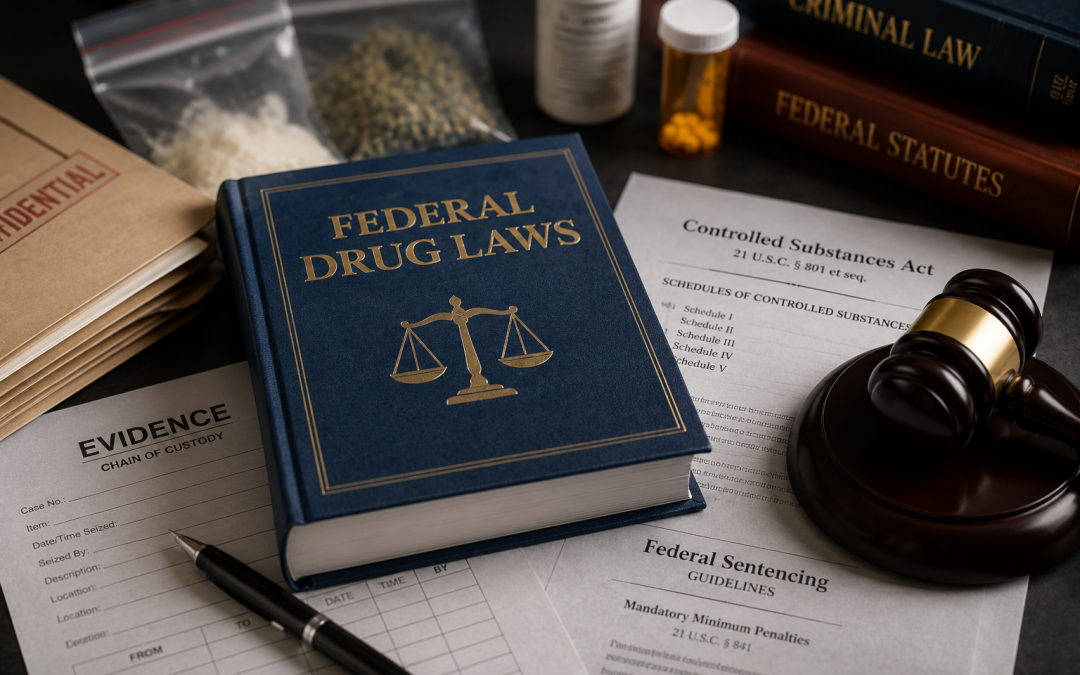
Federal drug laws regulate controlled substances throughout the United States. These laws cover possession, manufacturing, distribution, trafficking, conspiracy, drug-related premises, and the use of communication systems to facilitate an offense.
Penalties depend on the substance, quantity, alleged conduct, prior convictions, injuries, and other facts. Some offenses carry probation or short jail terms, while serious trafficking charges may trigger lengthy mandatory minimum sentences.
The Controlled Substances Act
The federal Controlled Substances Act provides the main framework for federal drug regulation. The law places controlled substances into five schedules based on medical use, abuse potential, safety, and risk of dependence.
Schedule I contains substances that federal law treats as having a high potential for abuse and no currently accepted medical use. Schedules II through V recognize varying medical uses and generally decrease in abuse or dependence risk. The DEA provides a current overview of the federal drug scheduling system.
A substance’s schedule affects how doctors, pharmacies, manufacturers, and researchers may handle it. However, the schedule alone does not determine the sentence in a criminal case.
Federal Simple Possession
Title 21 U.S.C. Section 844 prohibits knowingly or intentionally possessing a controlled substance without a valid prescription or other legal authorization.
A first offense can carry up to one year in federal prison and a minimum fine of $1,000. One qualifying prior conviction can increase the sentence to between 15 days and two years, with a minimum fine of $2,500. Two or more qualifying prior convictions can increase the range to between 90 days and three years, with a minimum fine of $5,000.
Possession cases often involve disputes about ownership, knowledge, prescriptions, and how officers found the substance. Her Lawyer’s guide on how to beat a drug possession charge discusses common evidence and search issues.
Manufacturing, Distribution, and Possession for Sale
Title 21 U.S.C. Section 841 prohibits knowingly or intentionally manufacturing, distributing, dispensing, or possessing a controlled substance with intent to distribute. The statute also covers certain counterfeit substances.
Federal trafficking penalties can depend heavily on drug type and quantity. Section 841 includes five-year and ten-year mandatory minimum tiers for specified quantities of substances such as fentanyl, heroin, cocaine, methamphetamine, PCP, and LSD.
In addition, penalties may increase when:
- Death or serious bodily injury results from use of the substance.
- The defendant has a qualifying prior conviction.
- A firearm was involved.
- The offense occurred near a school or another protected location.
- The conduct involved a minor.
- The defendant held a leadership role.
Charges involving sale or distribution generally carry much greater exposure than simple possession. Her Lawyer’s article on how to beat a felony drug charge explains related defense issues.
Federal Drug Conspiracy
A person does not need to complete a drug transaction to face federal charges. Under Title 21 U.S.C. Section 846, attempting or conspiring to commit a federal drug offense can carry the same penalties as the underlying offense.
As a result, prosecutors may charge several people connected to the same alleged operation. Evidence may include messages, financial records, surveillance, witness testimony, travel records, or statements from cooperating defendants.
The prosecution must still prove knowing participation. Mere presence, association, or a personal relationship with someone involved in drug activity does not automatically establish membership in a conspiracy.
Phones, Mail, and Internet Communications
Federal law also prohibits using a communication facility to facilitate a felony drug offense. Title 21 U.S.C. Section 843 covers mail, telephones, wire communications, radio, internet use, pictures, signals, and other communication methods. Each separate use may support a separate count.
Therefore, text messages, phone calls, social media conversations, online advertisements, and shipping communications may become important evidence. Prosecutors may also rely on search warrants for phones, email accounts, cloud storage, or social media records.
Drug-Involved Premises
Title 21 U.S.C. Section 856 prohibits knowingly opening, leasing, renting, using, or maintaining a place for manufacturing, distributing, storing, or using controlled substances. The statute may also apply to an owner or occupant who knowingly makes property available for unlawful drug activity.
A conviction may carry up to 20 years in federal prison, substantial fines, or both. The law can apply to permanent locations and temporary spaces.
Continuing Criminal Enterprise Charges
Federal prosecutors may pursue a continuing criminal enterprise charge against a person accused of organizing a large, ongoing drug operation. The government must prove a continuing series of drug violations involving at least five other people whom the defendant organized, supervised, or managed, along with substantial income or resources from the activity.
Under Title 21 U.S.C. Section 848, the general sentencing range begins at 20 years and can reach life imprisonment. Certain principal leaders of extremely large operations face mandatory life sentences.
Federal Sentencing and Mandatory Minimums
A federal sentence depends on both the criminal statute and the Federal Sentencing Guidelines. The statute establishes the minimum and maximum punishment, while the guidelines calculate an advisory range based on drug quantity, criminal history, weapon involvement, role in the offense, obstruction, and acceptance of responsibility.
Judges must consider the guideline range, but the guidelines do not guarantee a specific sentence. Her Lawyer’s federal sentencing guidelines overview explains how offense levels and criminal history categories affect the calculation.
Mandatory minimums can limit a judge’s sentencing options. However, certain defendants may qualify for statutory relief, including the safety valve or a government motion based on substantial assistance.
Property Forfeiture
Federal drug cases may also involve asset forfeiture. The government may seek controlled substances, alleged proceeds, vehicles, equipment, and real estate used to commit or facilitate qualifying offenses.
Forfeiture can proceed alongside the criminal case. Consequently, a defendant may face financial and property consequences before the court resolves every criminal charge.
Her Lawyer’s article on the prosecution of women for drug-related offenses discusses some broader effects drug prosecutions can have on families, employment, and financial stability.
FAQs About Federal Drug Laws
What makes a drug case federal?
A case may become federal because of the statute involved, a federal investigation, interstate or international conduct, federal property, mail or shipping activity, or the scale of the alleged operation.
Is every federal drug offense a felony?
No. Simple possession may qualify as a misdemeanor in some circumstances. Trafficking, manufacturing, conspiracy, and continuing criminal enterprise charges usually carry felony exposure.
Can state and federal drug laws differ?
Yes. Conduct allowed under state law may still violate federal law. Federal courts apply federal statutes regardless of how a state classifies the same substance or activity.
Does drug quantity always control the sentence?
No. Quantity matters greatly, but courts also consider the substance, criminal history, injuries, firearms, role in the offense, plea terms, and applicable sentencing relief.
Discuss a Federal Drug Charge With Her Lawyer
Federal drug charges may involve mandatory minimums, extensive digital evidence, asset forfeiture, and complex sentencing calculations. Early review can help identify the governing statute, evidence disputes, and possible sentencing consequences.
Contact Her Lawyer to discuss a federal drug investigation, possession allegation, trafficking charge, or related criminal defense matter.