
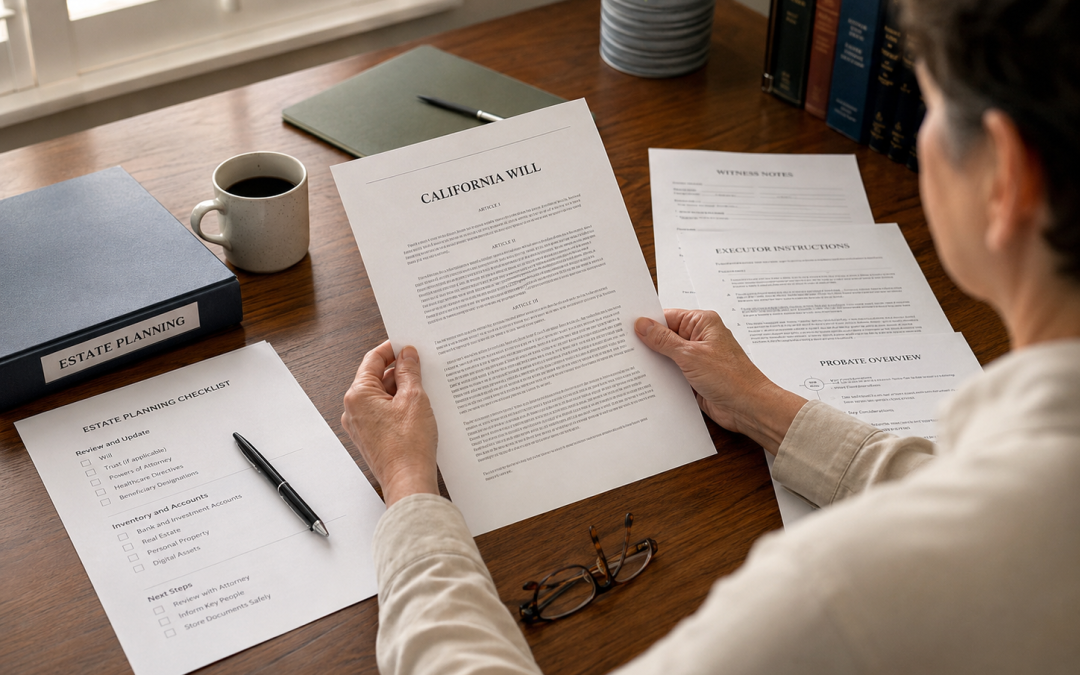
Forming a will in California allows a person to explain how certain property should pass after death, name an executor, choose beneficiaries, and make important estate planning decisions. A valid will can help reduce confusion and give the probate court clearer instructions.
A will does not control every asset. Property held in a living trust, jointly owned property, life insurance, retirement accounts, payable-on-death accounts, and transfer-on-death assets may pass outside the will. For that reason, a complete estate plan should review both the will and how each asset is titled.
What Is a Will?
A will is a legal document that states who should receive certain property after a person dies. The person making the will is often called the testator. The person named to manage the estate is usually called the executor.
A will may address:
- Beneficiaries
- Executor nomination
- Specific gifts
- Personal property
- Guardianship nominations for minor children
- Funeral or burial wishes
- Residue of the estate
- Backup beneficiaries
California Courts explains that a person may write their own will, hire legal help, or use a California Statutory Will form for a simple estate plan. The court’s wills, estates, and advance care planning guide also notes that a statutory will may fit people with relatively small estates.
Basic Requirements for a California Will
California Probate Code Section 6110 sets the basic execution requirements for many California wills. A will generally must be in writing, signed by the testator or by another person in the testator’s presence and direction, and witnessed by at least two people.
The witnesses should generally be present at the same time and understand that the document is the testator’s will. The will should also show that the testator intended the document to operate as a will.
A person making a will should use careful language. Vague gifts, unclear names, missing signatures, or witness problems may create probate disputes later.
Witnesses and Notarization
California wills usually require two witnesses unless another valid will type applies. The witnesses should sign the will during the proper execution process.
A notary does not replace the witness requirement for a standard California will. California’s statutory will instructions under Probate Code Section 6240 state that notarization will not fulfill the witness requirement.
Choosing witnesses carefully matters. A beneficiary who acts as a witness may create legal issues or presumptions, so many people choose neutral adult witnesses who are not receiving gifts under the will.
Holographic Wills in California
California recognizes holographic wills in some circumstances. A holographic will is a handwritten will.
Under Probate Code Section 6111, a will that does not comply with the usual witness rules may still be valid as a holographic will if the signature and material provisions are in the testator’s handwriting.
A holographic will does not need witnesses. However, handwritten wills can create problems if they are unclear, undated, partly typed, changed later, or difficult to interpret. A date can matter if there are questions about capacity or multiple wills.
California Statutory Will
California offers a statutory will form under Probate Code Section 6240. This form is designed to help people create a simple will based on California law.
The statutory will form can be useful for straightforward estates. However, it may not fit every situation. It may be too limited for blended families, tax planning, special needs planning, business interests, real estate in multiple states, disinheritance issues, complex beneficiary choices, or trust-based estate plans.
California Courts notes that a statutory will is a simple will for people with relatively small estates through its legal documents guide. A person with more complex needs should review whether a broader estate plan is more appropriate.
What to Include Before Signing
A will should be reviewed before signing to confirm that names, property descriptions, and beneficiary instructions are clear. The testator should also choose backup beneficiaries in case the first choice dies first or cannot receive the gift.
Helpful items to prepare may include:
- Full legal name
- Names of beneficiaries
- Names of backup beneficiaries
- Executor choice
- Backup executor choice
- List of major assets
- Personal property instructions
- Minor child guardian nomination
- Funeral or burial wishes
- Prior wills or codicils
- Trust documents, if any
The will should also coordinate with beneficiary designations. For example, a life insurance policy may pass to the beneficiary listed on the policy, even if the will says something different.
Executor Duties
The executor handles estate administration after death if probate is required. The executor may need to file court papers, locate assets, notify beneficiaries, address creditor claims, pay valid debts, and distribute property according to the will and court orders.
California Courts explains that probate is the court process for transferring property after someone dies through its probate guide. If the estate requires probate, the executor may need court appointment before acting on behalf of the estate.
A person making a will should choose someone responsible, organized, and trustworthy. The executor should also be willing to serve.
Will vs. Living Trust
A will and a living trust serve different purposes. A will can name beneficiaries and an executor, but it may still require probate. A living trust can hold assets during life and may help avoid formal probate if properly funded.
A will often works with a trust through a “pour-over” will. This type of will may direct remaining probate assets into a trust after death. However, assets that were never transferred to the trust may still require probate before they reach the trust.
A person who owns real estate, has minor children, wants privacy, or wants to reduce probate complications may want to compare a will-based plan with a trust-based plan.
Updating or Revoking a Will
A will may need updates after major life events. Marriage, divorce, childbirth, adoption, death of a beneficiary, property changes, business changes, or relocation can affect an estate plan.
Updates may be made through a new will or a codicil. A codicil is a formal amendment to an existing will. Because codicils can create confusion if they conflict with the original will, many people choose to create a new will instead.
The old will should not be marked up casually. Handwritten changes, crossed-out names, or unsigned edits can cause disputes in probate.
FAQs About Forming a Will in California
Does a California will need to be notarized?
No. Notarization does not replace the witness requirement for a standard California will. A properly executed will generally needs two witnesses unless another valid will type applies.
Can someone write their own will in California?
Yes. A person may write their own will, use a California Statutory Will form, or create a holographic will if legal requirements are met. However, unclear language can create probate disputes.
Does a will avoid probate in California?
Not by itself. A will can direct who receives probate assets, but probate may still be required unless assets pass through a trust, beneficiary designation, joint ownership, or a qualifying small estate procedure.
Can a handwritten will be valid in California?
Yes. A handwritten holographic will may be valid if the signature and material provisions are in the testator’s handwriting and other legal requirements are met.
Legal Help With Forming a Will in California
Forming a will can affect probate, beneficiaries, minor children, executor duties, real estate, family disputes, and future estate administration. A strong next step often depends on the estate size, asset titles, family structure, beneficiary goals, and whether a living trust may be more appropriate.
Her Lawyer, A Professional Law Corporation, assists with California family law and estate-related matters involving wills, trusts, probate, inheritance, and related planning issues. Contact Her Lawyer to request a confidential consultation and discuss possible next steps.