
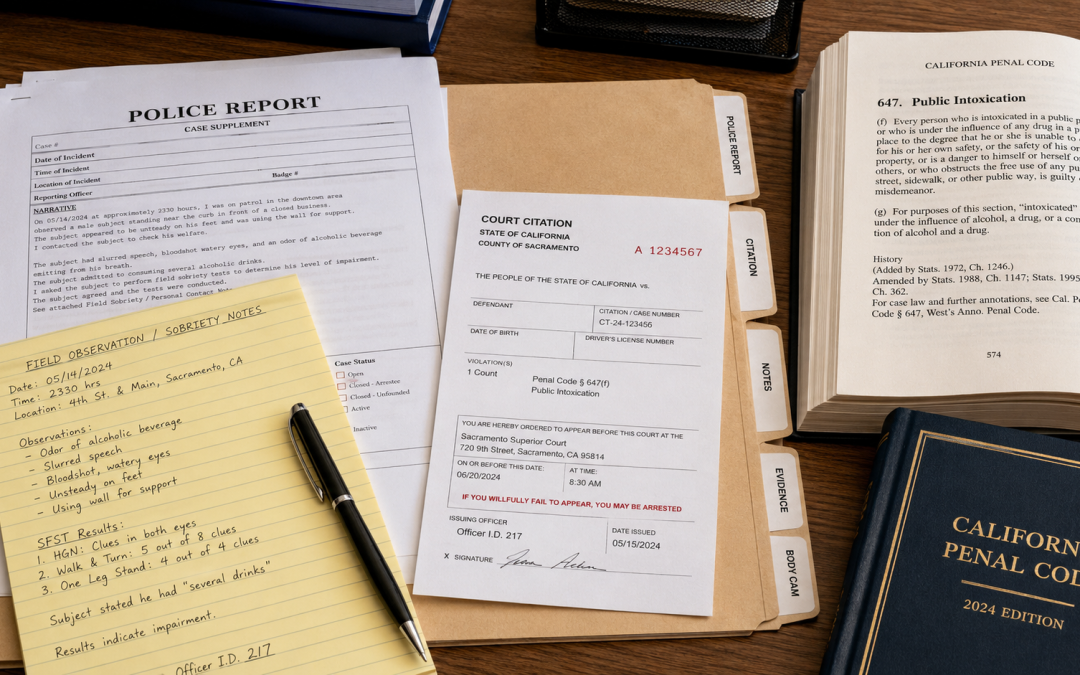
A public intoxication charge in California does not require proof that a person simply drank alcohol or used a controlled substance. Prosecutors must show more. The case usually turns on whether the person was in a public place and whether intoxication made the person unable to care for personal safety, unable to care for the safety of others, or obstructed a public way.
Because the legal standard involves more than being drunk in public, many cases depend on officer observations, video footage, witness statements, medical issues, location, and the person’s actual conduct. A defense may focus on whether the arresting officer had enough evidence to support every required element.
What Is Public Intoxication in California?
California addresses public intoxication under Penal Code Section 647(f). The statute applies when a person appears in a public place under the influence of alcohol, a drug, a controlled substance, toluene, or a combination of substances, and cannot exercise care for personal safety or the safety of others.
The statute also covers a person who interferes with, obstructs, or prevents the free use of a street, sidewalk, or other public way because of intoxication. Therefore, a prosecutor must usually prove more than intoxication alone.
For example, a person sitting quietly outside after drinking may not meet the same legal standard as a person blocking traffic, stumbling into a street, or creating a safety risk. The exact facts matter.
What Prosecutors Must Prove
California’s criminal jury instruction for public intoxication explains the elements prosecutors must prove. Under CALCRIM No. 2966, the prosecution must show the person was willfully under the influence in a public place and either could not exercise care for safety or interfered with a public way.
A public intoxication case often raises questions such as:
- Was the person in a public place?
- Did intoxication come from alcohol, drugs, or another listed substance?
- Could the person exercise care for personal safety?
- Did the person create a safety risk for others?
- Did the person block or interfere with a sidewalk, street, or public way?
- Did the officer confuse intoxication with a medical issue?
These questions matter because public intoxication does not punish private intoxication or mere drinking. Instead, the charge focuses on public safety and obstruction.
Common Defenses to Public Intoxication
A defense to public intoxication depends on the arrest report, body camera footage, location, witness statements, and medical facts. In many cases, the defense focuses on whether the prosecution can prove the required elements beyond a reasonable doubt.
Common defenses may include:
- The person was not in a public place
- The person was not intoxicated
- The person could exercise care for personal safety
- The person did not create a safety risk for others
- The person did not block a public way
- Police mistook a medical condition for intoxication
- Officer observations were incomplete or exaggerated
- Body camera footage does not support the report
- The arrest followed an unlawful detention
Medical issues can be especially important. Diabetes, seizures, fatigue, medication reactions, mental health symptoms, or head injuries may resemble intoxication. As a result, medical records, paramedic notes, hospital records, or witness observations may help explain the conduct.
Is Public Intoxication a Misdemeanor?
Public intoxication under Penal Code Section 647(f) is a misdemeanor disorderly conduct offense. When a misdemeanor statute does not provide a different punishment, Penal Code Section 19 allows up to six months in county jail, a fine of up to $1,000, or both.
However, many first-time cases do not result in the maximum penalty. Depending on the county, facts, record, and available mitigation, a case may involve dismissal, diversion, reduced charges, fines, community service, alcohol education, or other negotiated terms.
A conviction may still create consequences beyond court fines. Public intoxication can appear on a criminal background check, affect professional licensing, cause immigration concerns in some situations, or create problems if the person has probation in another case.
What Happens After a Public Intoxication Arrest?
After an arrest, law enforcement may book the person into jail or release the person with a citation. California’s misdemeanor citation statute, Penal Code Section 853.6, generally addresses citation and release procedures for misdemeanor arrests, although exceptions may apply.
The citation usually lists a court date. Missing that court date can create a bench warrant or additional failure-to-appear issues. Therefore, the court date and charging paperwork should be reviewed carefully.
After prosecutors review the case, they may file the charge, reject the case, or request more information. If prosecutors file the case, the defense may review discovery, negotiate with the prosecutor, seek a dismissal or reduction, or prepare for trial.
Her Lawyer’s article on public intoxication laws in California explains how Penal Code Section 647(f) works and what conduct may lead to an arrest.
Evidence That May Help Fight the Charge
Evidence can make a major difference in a public intoxication case. A police report may describe slurred speech, odor of alcohol, balance issues, aggressive behavior, or obstruction. However, video or witness evidence may tell a different story.
Helpful evidence may include:
- Body camera footage
- Surveillance video
- Witness statements
- Medical records
- Paramedic or hospital records
- Ride-share receipts
- Bar or restaurant receipts
- Photos of the location
- Citation and booking records
- Dispatch or 911 records
For instance, location evidence may show the person was not blocking a sidewalk or street. Likewise, medical evidence may show symptoms came from a health condition rather than intoxication.
FAQs About Fighting Public Intoxication Charges
Can a person be charged with public intoxication for being drunk outside?
Not always. Prosecutors must usually prove the person was in a public place and either could not exercise care for safety or interfered with a public way because of intoxication.
Does public intoxication require alcohol?
No. Penal Code Section 647(f) also covers intoxication from drugs, controlled substances, toluene, or a combination of listed substances.
Can a public intoxication charge be dismissed?
Yes, in some cases. A dismissal may depend on weak evidence, lack of public place proof, medical explanations, body camera footage, witness statements, or local diversion options.
Will public intoxication stay on a record?
A conviction can create a criminal record. However, some people may later qualify for record-clearing relief depending on the case outcome and eligibility.
Legal Help With a Public Intoxication Charge
A public intoxication charge may seem minor at first, but a misdemeanor record can create long-term consequences. The strongest defense often depends on the exact location, officer observations, video evidence, witness accounts, and whether the conduct truly met the Penal Code Section 647(f) standard.
Her Lawyer, A Professional Law Corporation, assists with California criminal defense matters involving public intoxication and related misdemeanor charges. Contact Her Lawyer to request a confidential consultation and discuss possible next steps.