
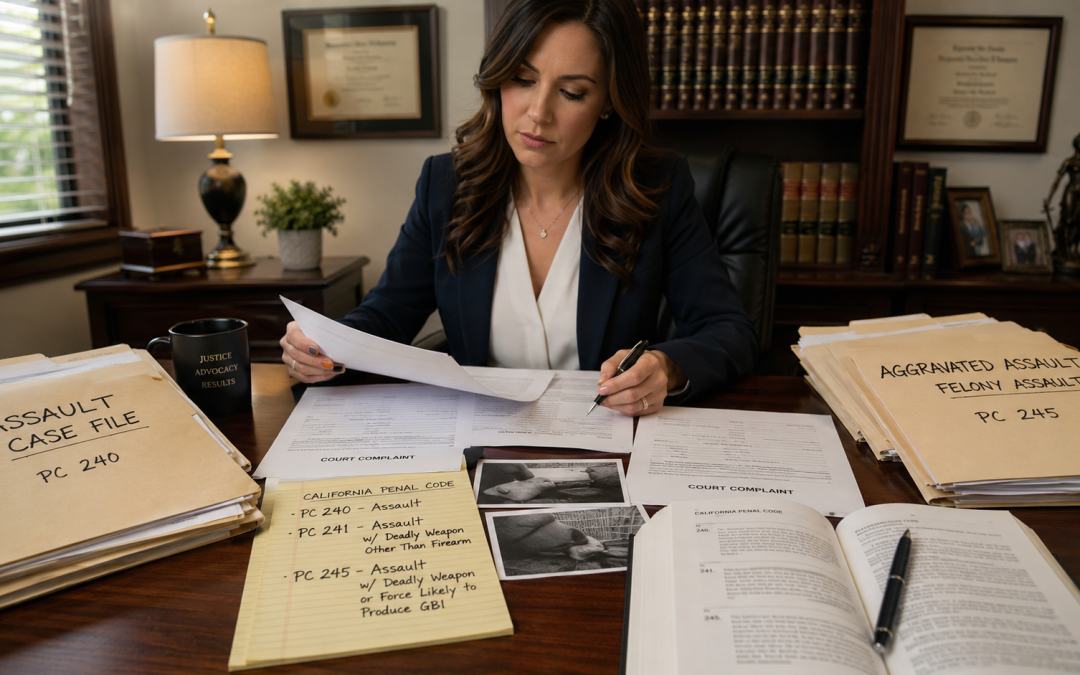
Assault and aggravated assault are often used as separate terms, but California law does not use “aggravated assault” as one single formal charge. Instead, California prosecutors may file simple assault, assault with a deadly weapon, assault with a firearm, or assault by force likely to produce great bodily injury, depending on the alleged facts.
The difference matters because simple assault usually carries misdemeanor penalties, while conduct commonly called aggravated assault can lead to felony exposure. A case may become more serious when prosecutors allege a weapon, serious injury risk, protected victim, or intent to commit another crime.
What Is Simple Assault in California?
Under Penal Code Section 240, assault means an unlawful attempt, combined with a present ability, to commit a violent injury on another person. Prosecutors do not need to prove physical contact or injury. Instead, the law focuses on an attempted use of force and whether the person had the present ability to carry it out.
For example, a person may face an assault charge after swinging and missing, raising a fist during a confrontation, or moving toward another person in a way prosecutors believe showed immediate ability to apply force. However, words alone usually do not create assault unless the words connect to conduct showing present ability.
Simple assault differs from battery. Battery involves the willful and unlawful use of force or violence on another person. In practical terms, assault can involve an attempted unlawful touching, while battery involves actual unlawful touching.
What Is Aggravated Assault in California?
California does not have one statute titled “aggravated assault.” However, people often use that phrase to describe more serious assault charges under Penal Code Section 245.
This statute covers several serious assault offenses, including assault with a deadly weapon, assault with a firearm, and assault by force likely to produce great bodily injury. In many cases, prosecutors use Penal Code Section 245 when they believe the alleged conduct created a higher risk of serious harm.
A deadly weapon does not always mean a gun or knife. Depending on the facts, prosecutors may argue a bottle, vehicle, tool, or other object became a deadly weapon because of how the person allegedly used it. Likewise, force likely to produce great bodily injury can involve punches, kicks, or other force prosecutors believe could cause significant injury.
Key Differences Between Assault and Aggravated Assault
The main difference involves the seriousness of the alleged conduct. Simple assault focuses on an attempted use of force. Aggravated assault, as people commonly use the term, usually involves a weapon, firearm, serious injury risk, or protected victim.
Important differences may include:
- Simple assault usually falls under Penal Code Section 240.
- Aggravated assault usually refers to charges under Penal Code Section 245.
- Simple assault often carries misdemeanor penalties.
- Aggravated assault may carry misdemeanor or felony penalties.
- Aggravated assault often involves a weapon, firearm, or force likely to cause great bodily injury.
- Injury is not always required for either charge.
Because the facts matter, two cases that look similar at first can lead to very different charges. For instance, a shove during an argument may lead to a simple assault or battery allegation. By contrast, swinging a heavy object, using a vehicle, or allegedly pointing a firearm may create exposure under Penal Code Section 245.
Penalties for Assault and Aggravated Assault
Simple assault generally carries lighter penalties. Under Penal Code Section 241, simple assault can carry up to six months in county jail, a fine of up to $1,000, or both.
Penalties increase when the alleged victim has a protected role, such as a peace officer, firefighter, emergency medical worker, traffic officer, code enforcement officer, or similar worker. In those cases, a conviction can carry up to one year in county jail and higher fines when the accused person knew or reasonably should have known the person’s role.
By comparison, Penal Code Section 245 can create much more serious exposure. Assault with a deadly weapon other than a firearm may carry two, three, or four years in state prison, up to one year in county jail, a fine of up to $10,000, or both. Assault by force likely to produce great bodily injury carries similar exposure.
The penalties can increase further when a firearm is involved. For example, assault with a firearm can carry two, three, or four years in state prison, while assault with a semiautomatic firearm can carry three, six, or nine years.
Can Aggravated Assault Be a Felony?
Yes. Conduct commonly called aggravated assault can become a felony in California. Penal Code Section 245 includes several “wobbler” offenses, meaning prosecutors may file the case as a misdemeanor or felony depending on the facts, injuries, record, and local charging practices.
Several facts can make felony filing more likely, including:
- Use of a firearm
- Use of a deadly weapon
- Serious injury or high injury risk
- Alleged violence against a protected worker
- Prior criminal history
- Evidence of threats before or after the incident
In addition, prosecutors may seek a sentencing enhancement if the case involves great bodily injury. California’s great bodily injury enhancement can add prison time when a person personally inflicts significant or substantial physical injury during a felony.
Her Lawyer’s article on 1st degree assault in California explains why California does not use that exact charge name and how serious felony assault charges work.
Common Defenses in Assault Cases
Assault defenses depend on the charge and evidence. Still, many cases turn on intent, present ability, self-defense, witness credibility, and whether the alleged conduct actually meets the statute.
Common defenses may include:
- The person lacked the present ability to use force
- The act was accidental
- The accused person acted in self-defense
- The accused person defended another person
- The alleged weapon was not used as a deadly weapon
- The force was not likely to cause great bodily injury
- Witnesses misunderstood the event
- Police reports left out important context
- Prosecutors cannot prove the charge beyond a reasonable doubt
Self-defense often becomes especially important in assault cases. California’s self-defense jury instruction allows reasonable force when a person reasonably believes immediate force is necessary to prevent imminent unlawful touching or injury. However, the force must remain reasonable under the circumstances.
FAQs About Assault vs. Aggravated Assault
Is aggravated assault a specific charge in California?
Not exactly. California does not use one statute called “aggravated assault.” People usually use the phrase to describe more serious assault charges, such as assault with a deadly weapon or assault by force likely to produce great bodily injury.
Does simple assault require injury?
No. Simple assault does not require physical contact or injury. Prosecutors must prove an unlawful attempt to use force and the present ability to do so.
Can aggravated assault be charged as a misdemeanor?
Sometimes. Certain Penal Code Section 245 offenses may be charged as misdemeanors or felonies. The filing decision often depends on the alleged weapon, injury risk, criminal history, and case facts.
What is the difference between assault and battery?
Assault involves an attempted unlawful use of force. Battery involves actual unlawful force or touching under California law.
Legal Help With California Assault Charges
The difference between assault and aggravated assault can affect jail exposure, felony risk, firearm rights, immigration concerns, restraining orders, and long-term criminal record consequences. Often, the most important issues involve the alleged weapon, injury evidence, witness accounts, video footage, and whether self-defense applies.
Her Lawyer, A Professional Law Corporation, assists with California criminal defense matters involving assault, battery, and related allegations. Contact Her Lawyer to request a confidential consultation and discuss possible next steps.