
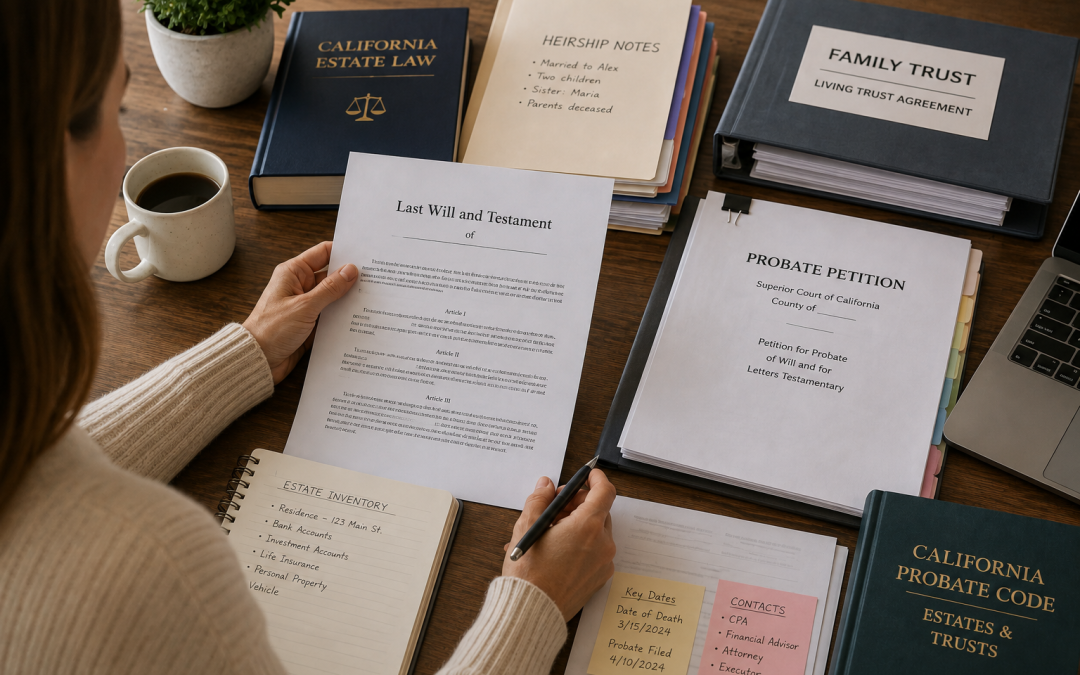
California inheritance laws determine who receives a person’s property after death. The answer often depends on whether the person had a valid will, living trust, beneficiary designation, surviving spouse, children, or other relatives.
Some assets pass through probate. Others may transfer outside probate through a trust, joint ownership, transfer-on-death designation, retirement account beneficiary, life insurance beneficiary, or small estate procedure. Because of this, inheritance questions usually begin with identifying what property exists and how title or beneficiary records are written.
Inheritance With a Will
A will lets a person name beneficiaries, choose an executor, nominate guardians for minor children, and explain how probate assets should pass after death. A valid will can guide the probate court and help reduce confusion among family members.
However, a will does not always control every asset. Property held in a trust, jointly owned property, life insurance, retirement accounts, and payable-on-death accounts may pass outside the will if the beneficiary or title documents say so.
California Courts explains that probate is the court process for transferring property after someone dies and that intestate succession applies when someone dies without a will. The court’s probate guide also explains that not every estate needs formal probate.
What Happens If Someone Dies Without a Will?
When someone dies without a will, California’s intestate succession laws decide who inherits probate property. These laws apply only to assets that do not pass another way, such as through a trust or beneficiary designation.
California Probate Code Section 6401 explains what a surviving spouse may inherit from the decedent’s intestate estate. The surviving spouse may receive all community property and part or all of separate property depending on whether the decedent left children, parents, siblings, or descendants of siblings.
California Probate Code Section 6402 explains how the remaining intestate estate passes when property does not pass entirely to a surviving spouse. The order may include children, parents, siblings, nieces and nephews, grandparents, aunts and uncles, and other relatives depending on who survived the decedent.
Surviving Spouse Rights
A surviving spouse may have important inheritance rights in California. Those rights can involve community property, quasi-community property, separate property, probate assets, and non-probate assets.
California is a community property state. In general, property acquired during marriage may be community property unless an exception applies. Separate property may include property owned before marriage, gifts, inheritances, and certain property kept separate.
If a spouse dies without a will, the surviving spouse’s intestate share depends on the type of property and the surviving family members. If the spouse dies with a will or trust, the documents may control many assets, but community property rights and other protections may still matter.
Children and Other Heirs
Children may inherit through a will, trust, beneficiary designation, or intestate succession. If there is no will, children often inherit separate property that does not pass entirely to a surviving spouse.
California inheritance questions can become more complex when the family includes adopted children, children born outside marriage, stepchildren, foster children, half-siblings, posthumous children, or disputed parentage. Parentage, adoption records, and family court orders may affect whether someone qualifies as an heir.
The California Courts probate glossary defines intestate succession as the order of who inherits when someone dies without a will. It also defines a successor as someone legally entitled to receive property under a will or the Probate Code.
Probate and Estate Administration
Probate is the court process for administering certain assets after death. The court may appoint a personal representative, confirm the will if one exists, oversee creditor notices, approve estate inventory, and supervise final distribution.
A probate case may involve:
- Filing a probate petition
- Giving required notices
- Appointing a personal representative
- Identifying estate assets
- Preparing an inventory and appraisal
- Paying valid debts and expenses
- Handling tax issues
- Resolving disputes
- Distributing property to heirs or beneficiaries
California Courts provides a guide to wills, estates, and probate court for people planning ahead or handling property after death. The guide explains that probate resources may help with estate planning documents and what happens after someone dies.
Small Estate Procedures
Formal probate may not be required for every estate. California allows simplified procedures for certain smaller estates after required waiting periods and when statutory requirements are met.
California Probate Code Section 13100 allows certain successors to collect or transfer personal property by affidavit when the estate qualifies and the required waiting period has passed. The statute was amended effective January 1, 2025.
California also has procedures for some real property. For example, Probate Code Section 13151 addresses a procedure involving a decedent’s California primary residence when the gross value does not exceed the statutory amount and 40 days have passed since death.
California Courts explains that formal probate may not be needed when the estate qualifies for simpler “summary succession” procedures. The court’s self-help guide also notes that the threshold amounts may be adjusted for inflation and property values.
Trusts, Beneficiary Designations, and Non-Probate Assets
Many inheritance transfers happen outside probate. A living trust may hold real estate, bank accounts, investments, or other property. When the trust is properly funded, the successor trustee may distribute assets under the trust terms without a full probate case.
Other non-probate transfers may include:
- Life insurance beneficiaries
- Retirement account beneficiaries
- Payable-on-death accounts
- Transfer-on-death registrations
- Joint tenancy property
- Community property with right of survivorship
- Certain trust-owned assets
These transfers can override expectations. For example, a will may leave everything to one person, but a retirement account beneficiary form may send that account to someone else.
Inheritance Disputes
Inheritance disputes may arise when family members disagree about a will, trust, beneficiary designation, executor conduct, trustee conduct, capacity, undue influence, missing assets, creditor claims, or heirship.
Common dispute issues include:
- Will contests
- Trust contests
- Undue influence
- Lack of capacity
- Elder financial abuse
- Missing estate assets
- Executor or trustee misconduct
- Beneficiary disputes
- Spousal property disputes
- Creditor disputes
- Disagreement over who qualifies as an heir
Evidence can matter. Helpful records may include wills, trusts, amendments, deeds, bank statements, beneficiary forms, medical records, emails, texts, caregiver records, financial powers of attorney, and prior estate planning documents.
FAQs About California Inheritance Laws
Who inherits if someone dies without a will in California?
California intestate succession laws decide who inherits probate property. A surviving spouse, children, parents, siblings, and other relatives may inherit depending on who survived the decedent and what type of property is involved.
Does a will avoid probate in California?
Not by itself. A will can direct who receives probate assets, but probate may still be required unless the assets pass through a trust, beneficiary designation, joint ownership, or a qualifying small estate procedure.
Can a surviving spouse inherit everything?
Sometimes. A surviving spouse may inherit all community property and may inherit some or all separate property depending on whether the decedent left children, parents, siblings, or other qualifying relatives.
Do all estates need formal probate?
No. Some estates may qualify for simplified procedures, small estate affidavits, trust administration, or other non-probate transfers depending on the assets and value.
Legal Help With California Inheritance Issues
California inheritance issues can affect probate, wills, trusts, surviving spouse rights, heirship, beneficiary disputes, estate assets, and family conflict. A strong next step often depends on the estate documents, asset titles, beneficiaries, family structure, property value, and whether probate is required.
Her Lawyer, A Professional Law Corporation, assists with California family law and estate-related matters involving inheritance, probate, trusts, wills, and related disputes. Contact Her Lawyer to request a confidential consultation and discuss possible next steps.