
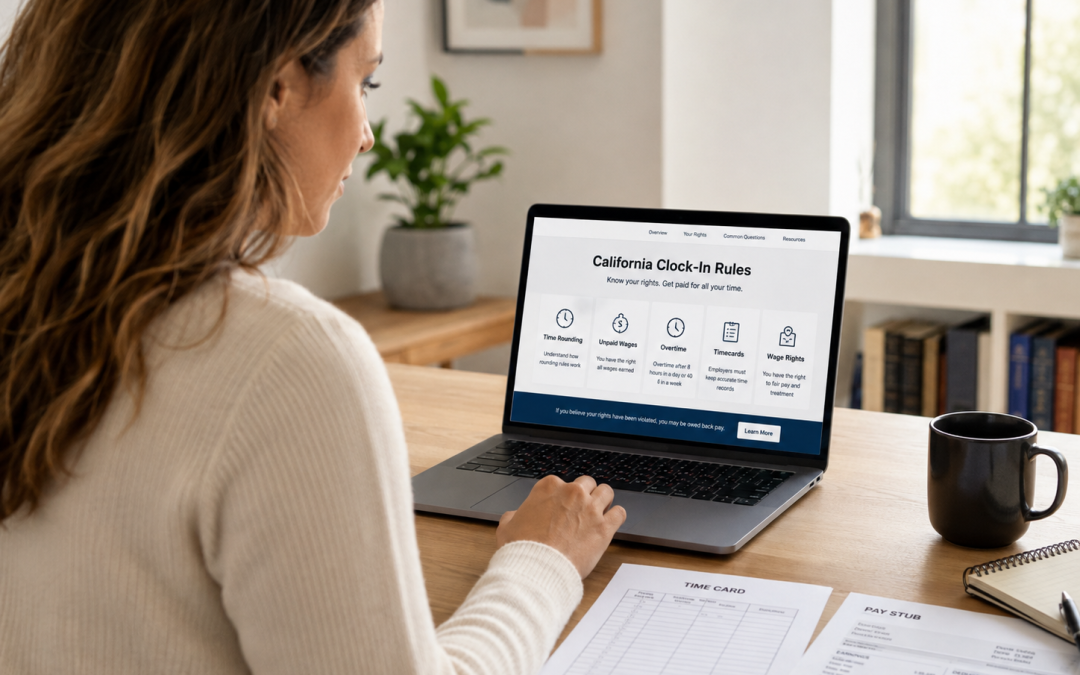
The 7-minute rule for clocking in refers to a common time-rounding practice where an employer rounds employee time to the nearest quarter hour. Under this practice, a clock-in from 8:00 to 8:07 may round to 8:00, while a clock-in from 8:08 to 8:14 may round to 8:15.
In California, this rule deserves careful review. Employers must pay nonexempt employees for all hours worked, and modern timekeeping systems often track exact minutes. A rounding policy that causes unpaid work, missed overtime, or inaccurate pay may create wage and hour issues.
What Is the 7-Minute Rule?
The 7-minute rule is part of quarter-hour rounding. It divides each 15-minute period into two parts. The first seven minutes usually round down, and the next eight minutes usually round up.
For example:
- 8:01 may round to 8:00
- 8:07 may round to 8:00
- 8:08 may round to 8:15
- 8:14 may round to 8:15
The rule may apply at clock-in, meal breaks, clock-out, or total daily time depending on the employer’s system. However, California law focuses on whether the employee receives pay for all compensable time worked.
Is the 7-Minute Rule Legal in California?
California law does not give employers a simple automatic right to use the 7-minute rule. A time-rounding policy may create risk when the employer can track the exact time worked and the rounding causes underpayment.
California Labor Code Section 510 requires overtime pay for many nonexempt employees who work more than eight hours in a workday, 40 hours in a workweek, or the first eight hours on the seventh consecutive day of work in a workweek.
California Labor Code Section 1194 also allows an employee receiving less than the legal minimum wage or overtime compensation to recover unpaid amounts in a civil action.
Because California wage laws strongly protect payment for work performed, rounding policies should not reduce employee pay for actual work time.
California Time Rounding Cases
California courts have limited time rounding in important ways. In Donohue v. AMN Services, LLC, the California Supreme Court rejected rounding for meal period time records and held that employers cannot round time punches for meal periods.
In Camp v. Home Depot U.S.A., Inc., a California Court of Appeal addressed a quarter-hour rounding policy where the employer tracked exact minutes. The court found the employer did not show it could rely on rounding when records showed the employee lost compensable time. The California Supreme Court granted review in Camp, and the broader time-rounding issue has remained important for California employers and workers.
These cases do not mean every historical rounding issue has the same answer. Still, they show California courts closely review policies that round time instead of paying employees according to exact records.
Exact Timekeeping and Modern Payroll Systems
Many employers now use digital timekeeping systems that record exact clock-in and clock-out times. When an employer can track exact minutes, using rounded time may create problems if the rounded time pays less than the actual work time.
For example, an employee may clock in at 7:53, start required pre-shift work, and then have time rounded to 8:00. If the employee worked during those seven minutes, the employer may owe pay for that time.
Important questions may include:
- Did the employee perform work before the rounded start time?
- Did the employer know or should it have known about the work?
- Did rounding reduce total paid time?
- Did rounding affect overtime?
- Did the same rounding practice consistently benefit the employer?
- Did meal period rounding hide late, short, or missed meals?
The answer depends on the time records, workplace policy, and actual work performed.
Unpaid Work Before or After a Shift
Clock-in rounding can create wage issues when employees perform work before or after scheduled shifts. A few minutes each day can add up over weeks or months.
Pre-shift or post-shift work may include:
- Starting computers or systems
- Unlocking doors
- Preparing equipment
- Checking assignments
- Attending pre-shift meetings
- Cleaning work areas
- Passing through required security checks
- Closing registers
- Completing required reports
- Waiting under employer control
California Labor Code Section 204 sets regular payday requirements for wages earned. If an employer requires or permits work, the employer generally should pay for that work.
How Rounding Can Affect Overtime
The 7-minute rule can also affect overtime. California overtime rules often depend on daily and weekly hours. If rounding removes minutes from the start or end of a shift, the employee’s records may show fewer hours than actually worked.
For example, an employee may work from 8:53 a.m. to 5:07 p.m. with a 30-minute meal break. If the employer rounds the time in a way that removes compensable minutes, the employee may lose regular wages or overtime depending on the total hours worked.
Overtime issues may involve:
- Daily overtime over eight hours
- Weekly overtime over 40 hours
- Seventh-day overtime
- Double-time thresholds
- Missed meal or rest break premiums
- Split shift or reporting time issues, depending on the facts
Accurate time records matter because small rounding changes can affect larger wage calculations.
Meal Breaks and the 7-Minute Rule
Meal break rounding creates special risk in California. The California Supreme Court’s Donohue decision held that employers cannot round time punches for meal periods.
California Labor Code Section 512 requires meal periods for many employees who work more than certain hour thresholds. If an employer fails to provide a legally compliant meal period, the employee may receive one additional hour of pay under California Labor Code Section 226.7.
For example, rounding a 28-minute meal period to 30 minutes may hide a short meal period. Rounding a late meal period may also hide whether the employer provided the break on time.
Timecard Records That May Help
Employees reviewing a possible 7-minute rule issue should preserve timekeeping and payroll records. The goal is to compare actual punches with paid time.
Helpful records may include:
- Clock-in and clock-out records
- Payroll summaries
- Wage statements
- Work schedules
- Meal period records
- Overtime records
- Texts or emails about start times
- Pre-shift meeting notices
- Closing task lists
- Timekeeping policy
- Employee handbook
- Notes showing actual work performed
A worker should keep records lawfully and avoid taking confidential company files outside authorized access.
What If Rounding Reduced Pay?
A worker who believes rounding reduced pay may consider a wage claim or another legal option. The next step often depends on the amount of unpaid time, whether overtime was affected, whether meal periods were rounded, and whether other employees experienced the same issue.
The California Labor Commissioner accepts wage claims involving unpaid wages, overtime, commissions, vacation pay, and other wage issues. A worker may also need to review deadlines because wage claims and civil lawsuits can have different time limits.
Her Lawyer’s article on California employment laws and employee rights explains related wage and workplace protections.
FAQs About the 7-Minute Rule for Clocking In
What is the 7-minute rule for clocking in?
The 7-minute rule usually refers to quarter-hour rounding. Time from one to seven minutes may round down, while time from eight to fourteen minutes may round up to the next quarter hour.
Can a California employer round clock-in time?
California law closely limits time rounding, especially when exact time records exist. A rounding policy may create legal risk if it causes employees to lose pay for actual time worked.
Can an employer round meal break punches in California?
No. The California Supreme Court held in Donohue v. AMN Services that employers cannot round time punches for meal periods.
What records help prove unpaid time from rounding?
Helpful records may include actual time punches, paid time summaries, wage statements, schedules, meal records, overtime records, timekeeping policies, and notes showing work performed before or after rounded time.
Legal Help With Clock-In Rounding Issues
The 7-minute rule for clocking in can affect regular wages, overtime, meal breaks, final pay, wage statements, and broader wage claims. A strong next step often depends on the actual time records, paid time records, employer policy, work duties, overtime calculations, and whether meal periods were rounded.
Her Lawyer, A Professional Law Corporation, assists with California employment matters involving unpaid wages, overtime, timekeeping issues, meal and rest breaks, retaliation, and workplace rights. Contact Her Lawyer to request a confidential consultation and discuss possible next steps.