
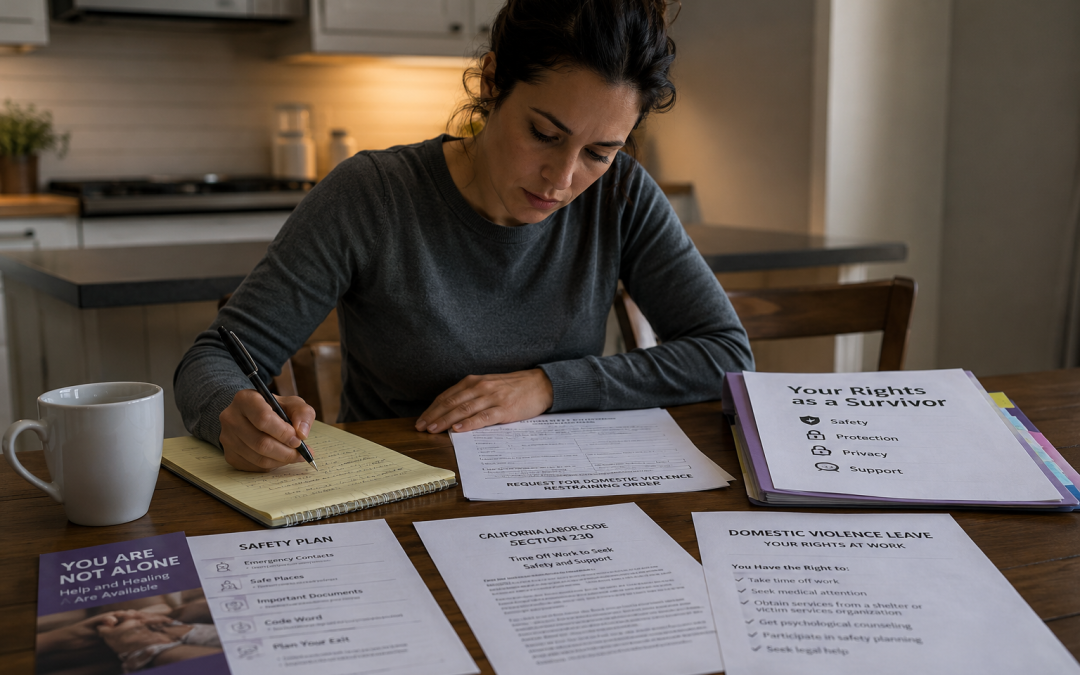
Domestic violence survivors in California may have legal rights involving protection orders, workplace leave, housing safety, privacy, victim compensation, custody, and criminal court participation. These rights can help a survivor seek protection, preserve employment, relocate safely, and document abuse.
Domestic violence can involve physical harm, threats, stalking, harassment, coercive control, sexual abuse, financial control, isolation, or repeated intimidation. California law recognizes domestic violence in several legal contexts, so a survivor’s options often depend on the relationship, safety concerns, evidence, housing situation, employment status, and whether children are involved.
Domestic Violence Restraining Orders
A domestic violence restraining order can protect a survivor from a current or former spouse, dating partner, co-parent, close family member, or someone with another qualifying relationship. California’s Domestic Violence Prevention Act defines domestic violence through Family Code Section 6203 and qualifying relationships through Family Code Section 6211.
A restraining order may require the restrained person to stop contact, stay away, move out, surrender firearms, avoid harassment, and follow child custody or visitation terms. The California Courts Self-Help Guide explains the restraining order process and notes that a domestic violence restraining order can provide protection quickly in urgent cases.
Evidence may include photos, text messages, emails, call logs, medical records, police reports, witness statements, social media messages, or a written timeline. However, each case depends on the facts and the specific protection requested.
Rights in the Criminal Case
A survivor may have rights in a criminal case if prosecutors file charges after a domestic violence report. California crime victims have rights under Marsy’s Law, including the right to be treated with fairness and respect, receive certain notices, be heard at certain proceedings, and seek restitution when available.
A domestic violence criminal case belongs to the state, not the survivor. This means prosecutors decide whether to file, reduce, or dismiss charges. Still, the survivor may provide information, request notice, ask about protective orders, and communicate safety concerns through the prosecutor’s victim services staff.
Criminal protective orders can also affect contact, child exchanges, housing, and firearm possession. If family court and criminal court orders both exist, the survivor should review the exact terms because overlapping orders can create confusion.
Workplace Rights and Protected Leave
California employees who experience domestic violence, sexual assault, stalking, or other qualifying crime or abuse may have workplace protections. Under Labor Code Section 230, an employer cannot discharge, discriminate, or retaliate against an employee for taking time off for certain protected reasons, including seeking a restraining order or other court relief.
Additional protections may apply under Labor Code Section 230.1 for employers with 25 or more employees. Protected reasons can include seeking medical attention, obtaining services from a shelter or victim services organization, receiving psychological counseling, safety planning, or taking other steps to address domestic violence or related abuse.
Employers must also keep certain domestic violence leave information confidential to the extent allowed by law. If an employer fires, demotes, threatens, or reduces hours because of protected leave, the employee may have a retaliation claim.
Housing and Relocation Rights
Domestic violence can create urgent housing concerns. In some situations, a California tenant may have the right to end a lease early after domestic violence, sexual assault, stalking, human trafficking, elder abuse, or other qualifying abuse.
California Civil Code Section 1946.7 allows certain tenants, household members, or immediate family members affected by qualifying abuse to terminate a tenancy with proper written notice and documentation. The statute includes specific rules about timing, documentation, and rent obligations.
Housing safety may also involve changing locks, requesting repairs, documenting harassment, or protecting a confidential address. California’s Safe at Home program can provide a substitute mailing address for eligible survivors of domestic violence, stalking, sexual assault, human trafficking, child abduction, and other qualifying abuse as part of a broader safety plan.
Financial Help and Victim Compensation
Survivors may need help with medical bills, counseling, relocation, lost income, or safety-related costs. The California Victim Compensation Board explains that CalVCB may provide compensation for eligible victims of violent crime, including domestic violence, when the program’s requirements are met.
Victim compensation is separate from a civil lawsuit, criminal restitution, or support order. Eligibility can depend on reporting, cooperation requirements, expenses, deadlines, and whether another source already covers the loss.
A survivor may also have family law rights involving child support, spousal support, property division, or temporary financial orders. If the abuse affected access to money, housing, documents, or employment, those facts may matter when the court reviews temporary needs and safety issues.
Privacy, Safety, and Documentation
Privacy often becomes a major issue after domestic violence. A survivor may need to protect a home address, phone number, children’s school information, medical records, court filings, and digital accounts.
Important safety steps may include:
- Saving threatening messages and voicemails
- Taking screenshots with dates and usernames
- Keeping copies of police reports and medical records
- Changing passwords and account recovery settings
- Checking location sharing on phones, apps, and vehicles
- Storing documents somewhere safe
- Creating a safety plan with a qualified advocate
Technology abuse can involve tracking apps, shared cloud accounts, smart home devices, vehicle access, or social media monitoring. For that reason, digital safety may matter as much as physical safety in some cases.
FAQs About Domestic Violence Survivor Rights
Can a survivor get a restraining order without a police report?
Yes. A police report can help, but California courts can consider other evidence, including declarations, messages, photos, medical records, and witness statements.
Can an employee take time off work because of domestic violence?
Yes, California law protects certain time off related to domestic violence, including seeking court protection, medical care, counseling, victim services, and safety planning when the legal requirements apply.
Can a survivor leave a lease early because of domestic violence?
Sometimes. Civil Code Section 1946.7 allows qualifying tenants to terminate a lease early with proper written notice and documentation when the statute applies.
Can a survivor keep a new address confidential?
California’s Safe at Home program may help eligible survivors use a substitute mailing address as part of a safety plan. The program does not replace all safety planning, but it can reduce public address exposure.
Legal Help for Domestic Violence Survivors
Domestic violence can affect safety, housing, employment, custody, finances, immigration concerns, privacy, and future court orders. The strongest next steps often depend on the survivor’s immediate safety, relationship to the abusive person, available evidence, workplace needs, housing situation, and whether children are involved.
Her Lawyer, A Professional Law Corporation, assists with California family law and related matters involving domestic violence, restraining orders, custody, support, and safety-related legal issues. Contact Her Lawyer to request a confidential consultation and discuss possible next steps.