
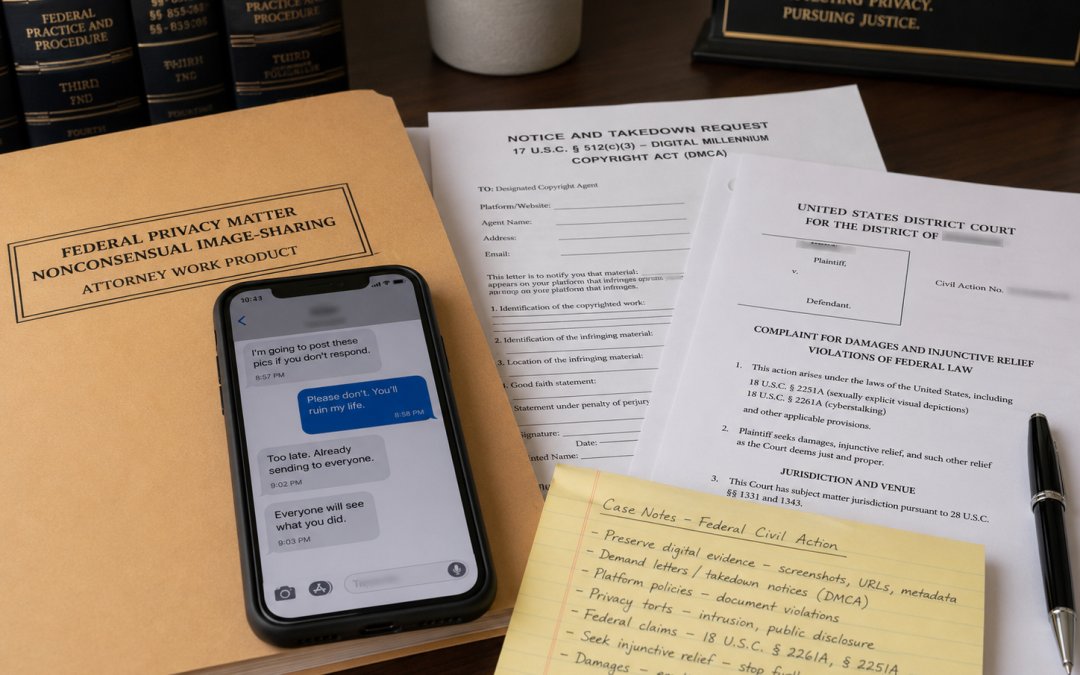
Revenge porn can now be a federal crime in certain cases. In 2025, Congress passed the TAKE IT DOWN Act, a federal law addressing the nonconsensual online publication of intimate visual depictions, including certain AI-generated deepfakes.
Before this law, many revenge porn cases depended mostly on state criminal statutes, civil claims, stalking laws, harassment laws, or platform policies. Now, federal law may apply when a person knowingly publishes or threatens to publish certain intimate images without consent through an interactive computer service and the required interstate or foreign commerce connection exists.
What Is Revenge Porn?
“Revenge porn” usually means sharing intimate images or videos of another person without consent. The term can be misleading because revenge does not always need to be the motive. A person may distribute intimate images to embarrass, threaten, pressure, exploit, or harm someone.
Federal law uses terms such as nonconsensual intimate visual depictions rather than “revenge porn.” Under the TAKE IT DOWN Act, the law covers certain intimate visual depictions of identifiable people when publication happens without consent and the statutory requirements apply.
The law also reaches some digital forgeries. A “digital forgery” can include an intimate image created or altered through software, artificial intelligence, machine learning, or another technological process when the result appears realistic.
When Is Revenge Porn a Federal Crime?
Federal criminal law now prohibits certain intentional disclosures of nonconsensual intimate visual depictions under 47 U.S.C. Section 223(h). The law applies to adults and minors, but it treats those categories differently.
For an adult victim, prosecutors generally must prove the person knowingly published an intimate visual depiction of an identifiable adult without consent through an interactive computer service in interstate or foreign commerce. The law also requires facts showing the image was not voluntarily exposed in a public or commercial setting, and the publication caused or was reasonably likely to cause harm.
The law separately addresses minors. Publishing certain intimate visual depictions of minors can carry federal penalties even when the image involves a digital forgery. Other federal child exploitation laws may also apply depending on the facts.
In practical terms, many online postings may involve interstate commerce because websites, apps, phones, cloud storage, and social media platforms often use interstate communications. Still, federal jurisdiction depends on the exact facts.
What Penalties Can Apply?
Federal penalties depend on whether the depicted person is an adult or a minor. Under 47 U.S.C. Section 223(h), unlawful publication involving an identifiable adult can carry a fine, imprisonment for up to two years, or both.
When the violation involves an identifiable minor, federal law can carry a fine, imprisonment for up to three years, or both. The court must also order forfeiture of certain property connected to the offense when the statute requires it.
These penalties do not replace every other possible charge. Depending on the facts, prosecutors may also consider federal cyberstalking, extortion, child exploitation, harassment, or state-law charges.
Platform Takedown Rules
The TAKE IT DOWN Act also creates removal duties for certain covered platforms. Under 47 U.S.C. Section 223a, covered platforms must maintain a clear process for receiving removal requests involving nonconsensual intimate visual depictions.
A valid request generally must identify the image, provide information sufficient for the platform to locate it, include a statement of good-faith belief that the image is nonconsensual, and include contact information for the person making the request. After receiving a valid request, the covered platform must remove or disable access to the image as soon as possible and generally no later than 48 hours.
The Federal Trade Commission enforces the platform compliance requirements. Failure to reasonably comply can be treated as an unfair or deceptive act or practice under federal law.
Federal Civil Claims for Nonconsensual Image Sharing
A person depicted in nonconsensually shared intimate images may also have a federal civil claim. Under 15 U.S.C. Section 6851, a person whose intimate visual depiction is disclosed without consent, in or affecting interstate or foreign commerce, may bring a civil action when the statutory requirements are met.
A civil claim can seek relief such as damages, statutory damages, punitive damages, attorney’s fees, and injunctive relief when available under the statute. Civil claims differ from criminal prosecution because the injured person brings the lawsuit directly rather than relying on prosecutors to file charges.
However, the civil statute includes exceptions. For example, it does not cover commercial pornographic content unless force, fraud, misrepresentation, or coercion produced the content. The law also recognizes certain good-faith disclosures, such as disclosures connected to law enforcement, legal proceedings, medical treatment, education, or reporting unlawful content.
California Revenge Porn Law
Federal law does not erase state revenge porn laws. In California, prosecutors may still use Penal Code Section 647(j)(4) when someone intentionally distributes certain private intimate images without consent and the statutory requirements apply.
California also allows a civil lawsuit under Civil Code Section 1708.85 for certain nonconsensual distributions of intimate material. As a result, one case may involve federal law, California criminal law, civil claims, platform takedown requests, or a combination of remedies.
Her Lawyer’s article on whether revenge porn is sexual assault explains how California usually treats revenge porn as a separate privacy and image-based abuse offense rather than traditional sexual assault.
Evidence in a Federal Revenge Porn Case
Revenge porn cases often depend on digital evidence. The strongest evidence usually connects the image, the person who posted or threatened to post it, the platform, the timing, and the lack of consent.
Helpful evidence may include:
- Screenshots showing URLs, usernames, dates, and captions
- Messages threatening to publish intimate images
- Platform takedown requests
- Emails, texts, or direct messages
- Account records or login information
- Cloud storage or device records
- Police reports
- Civil complaint records
- Evidence of emotional, financial, or reputational harm
Evidence should preserve context whenever possible. Cropped screenshots may miss usernames, timestamps, surrounding messages, or platform details needed to support a criminal report, civil claim, or takedown request.
FAQs About Revenge Porn as a Federal Crime
Is revenge porn a federal crime now?
Yes, revenge porn can be a federal crime when the facts meet the requirements of the TAKE IT DOWN Act and the federal statute on nonconsensual intimate visual depictions.
Does federal law cover AI-generated deepfake intimate images?
Yes. Federal law covers certain digital forgeries, including some AI-generated intimate depictions, when the image appears realistic and the statutory requirements apply.
Do platforms have to remove revenge porn?
Covered platforms must provide a removal process and generally remove or disable access to validly reported nonconsensual intimate visual depictions as soon as possible and no later than 48 hours after receiving a valid request.
Can someone sue for revenge porn in federal court?
Yes. Federal law allows a civil action for certain nonconsensual disclosures of intimate visual depictions when the disclosure occurs in or affects interstate or foreign commerce and the statute’s requirements are met.
Legal Help With a Revenge Porn Case
A revenge porn case can involve federal criminal law, California criminal charges, civil claims, platform takedown requests, privacy concerns, restraining orders, and emotional harm. The strongest next steps often depend on where the image appeared, who posted it, whether threats were made, and what evidence remains available.
Her Lawyer, A Professional Law Corporation, assists with California matters involving nonconsensual image sharing, privacy violations, and related criminal defense issues. Contact Her Lawyer to request a confidential consultation and discuss possible next steps.