
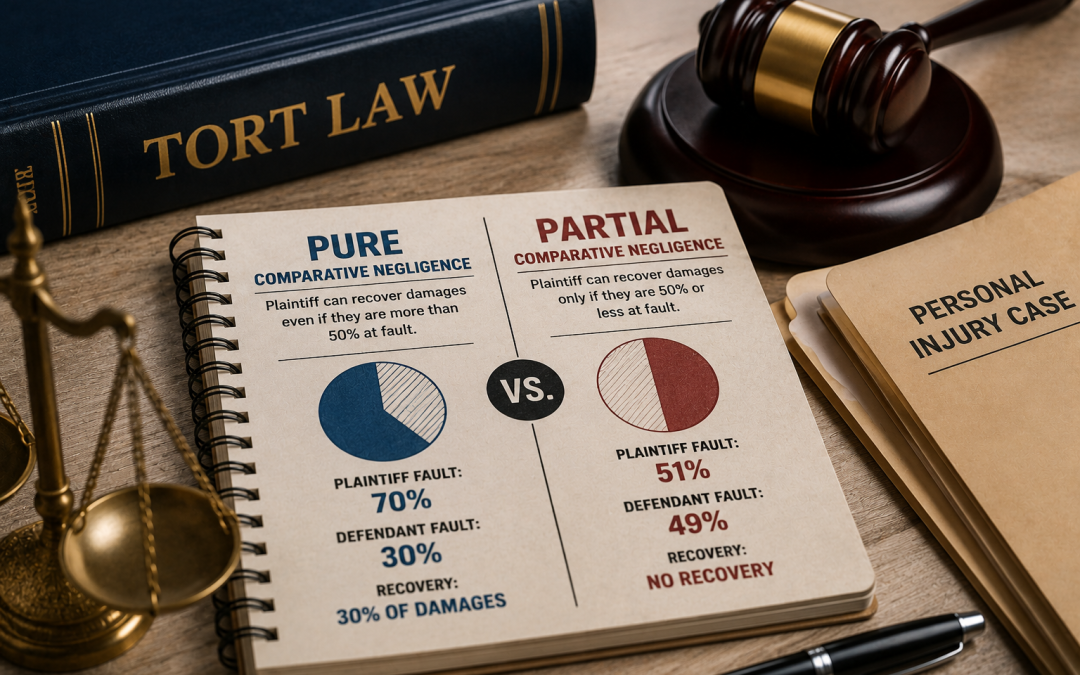
Pure vs. partial comparative negligence matters when more than one person shares fault for an accident. These rules decide whether an injured person can recover damages and how much compensation may be reduced.
“Partial comparative negligence” is often called modified comparative negligence. The main difference is simple: pure comparative negligence allows recovery even when the injured person is mostly at fault, while partial comparative negligence cuts off recovery after a certain fault percentage.
What Is Comparative Negligence?
Comparative negligence divides fault between the parties in a civil injury case. Instead of asking only who caused the accident, the court or insurer assigns each party a percentage of responsibility.
For example, a jury may find the plaintiff 20% at fault and the defendant 80% at fault. If total damages equal $100,000, the plaintiff’s recovery may drop to $80,000.
Cornell Law School’s overview of comparative negligence explains how this doctrine reduces damages based on the plaintiff’s share of fault.
Her Lawyer’s guide to comparative negligence explains how fault percentages may affect settlements and trials.
Pure Comparative Negligence
Pure comparative negligence allows an injured person to recover some damages even when the injured person is mostly responsible for the accident.
The recovery is reduced by the person’s percentage of fault.
For example, if a plaintiff has $100,000 in damages but is 70% at fault, the plaintiff may still recover $30,000. The recovery is smaller, but the claim is not completely barred.
This rule can apply even when the plaintiff is 90% or 99% at fault. The plaintiff may still recover the portion of damages caused by the defendant’s fault.
Partial Comparative Negligence
Partial comparative negligence, more commonly called modified comparative negligence, allows recovery only when the plaintiff’s fault stays below a set limit.
Most modified systems use one of two rules:
- 50% bar rule
- 51% bar rule
Under a 50% bar rule, a plaintiff cannot recover if the plaintiff is 50% or more at fault. The plaintiff must be less at fault than the defendant.
Under a 51% bar rule, a plaintiff cannot recover if the plaintiff is more than 50% at fault. A plaintiff who is exactly 50% at fault may still recover half of the damages.
This distinction matters in close cases. A 50/50 accident may allow recovery in one state and block recovery in another.
Example of Pure vs. Partial Comparative Negligence
Assume a plaintiff suffers $100,000 in damages after a car accident. A jury finds the plaintiff 60% at fault and the defendant 40% at fault.
In a pure comparative negligence state, the plaintiff may recover $40,000.
In a partial comparative negligence state, the plaintiff may recover nothing if the state bars recovery when the plaintiff is more than 50% at fault.
The same facts can lead to different results depending on state law.
California’s Comparative Fault Rule
California follows pure comparative negligence. The California Supreme Court adopted this rule in Li v. Yellow Cab Co., replacing the older contributory negligence rule.
Under California law, a plaintiff’s fault reduces damages in proportion to the plaintiff’s responsibility. Partial fault does not automatically prevent recovery.
This rule often matters in car accidents, slip and fall cases, dog bite claims, premises liability lawsuits, and other personal injury matters.
Her Lawyer’s article on negligence laws by state explains how state rules differ across the country.
How Fault Percentages Affect Settlement
Fault percentages often shape settlement negotiations before a case reaches trial. Insurance companies may reduce an offer if they believe the injured person contributed to the accident.
For example, an insurer may argue a pedestrian crossed outside a crosswalk, a shopper ignored a warning sign, or a driver was speeding before a crash. The injured person may respond with evidence showing the defendant caused most of the harm.
Important evidence may include photos, video, witness statements, police reports, medical records, inspection logs, and expert opinions.
Even a small change in fault can affect settlement value. In modified comparative negligence states, a few percentage points can decide whether the plaintiff recovers anything at all.
Comparative Negligence vs. Contributory Negligence
Comparative negligence should not be confused with contributory negligence.
Contributory negligence is much stricter. Under that system, an injured person may recover nothing if the injured person contributed to the accident at all. Cornell Law School’s definition of contributory negligence describes how this rule can bar recovery when the plaintiff’s own negligence helped cause the harm.
Only a few jurisdictions still use contributory negligence. Most states use pure or modified comparative negligence instead.
FAQs About Pure vs. Partial Comparative Negligence
Is partial comparative negligence the same as modified comparative negligence?
Yes, in most discussions. “Partial comparative negligence” usually refers to modified comparative negligence, where recovery ends once the plaintiff’s fault reaches a certain threshold.
Which rule does California use?
California uses pure comparative negligence. A plaintiff’s damages are reduced by the plaintiff’s percentage of fault, but partial fault does not automatically bar recovery.
Can a plaintiff recover when mostly at fault?
In a pure comparative negligence state, yes. In a modified or partial comparative negligence state, usually no if the plaintiff’s fault exceeds the state’s limit.
Why does the 50% or 51% rule matter?
The threshold can decide whether a plaintiff receives reduced damages or no damages at all. A plaintiff who is exactly 50% at fault may recover in a 51% bar state but not in a 50% bar state.
Legal Help With Comparative Fault Issues
Comparative fault can change the value of a personal injury claim. The governing state law, evidence, and assigned fault percentage all matter.
Her Lawyer’s California personal injury attorneys assist with injury claims involving disputed fault and settlement value. Contact Her Lawyer to discuss a comparative negligence or personal injury matter.