
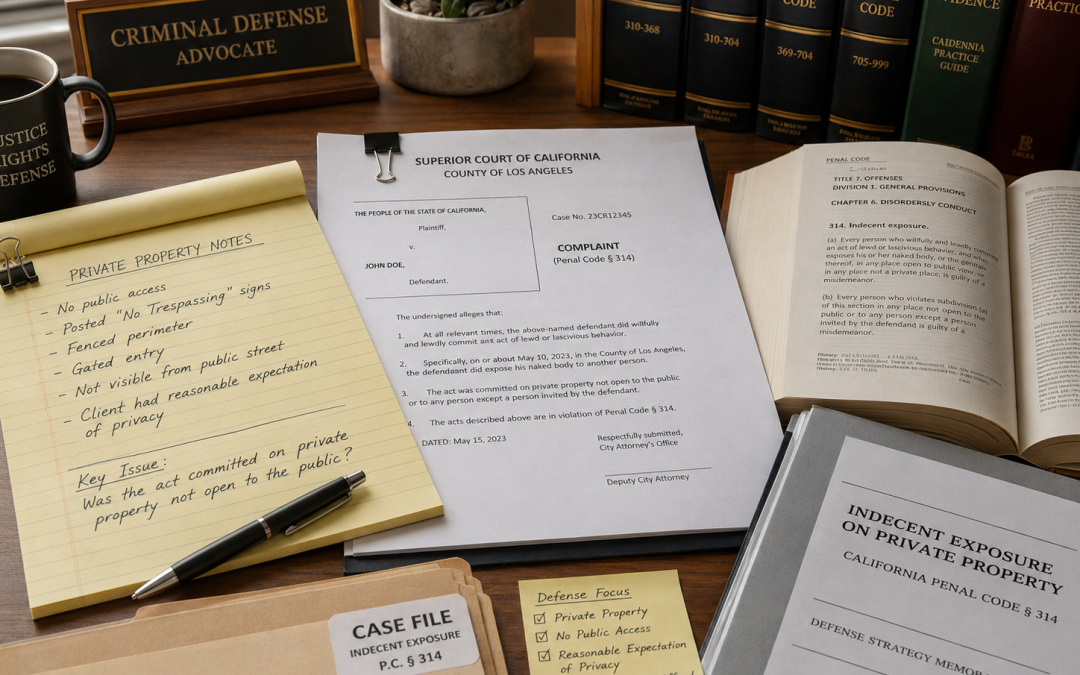
Indecent exposure on private property can still lead to criminal charges in California. Although many people associate indecent exposure with public places, California law also covers certain conduct in a place where other people are present and may be offended or annoyed.
The charge usually depends on more than nudity alone. Prosecutors often need evidence showing intentional exposure, the setting, the presence of others, and a sexual or offensive purpose. As a result, private property cases may turn on visibility, intent, witness statements, video evidence, and the exact facts surrounding the incident.
Can Indecent Exposure Happen on Private Property?
Yes. California’s indecent exposure statute applies when a person willfully and lewdly exposes private parts in a public place or in a place where other people are present and may be offended or annoyed.
That second part matters. A person does not need to stand on a sidewalk, street, park, or other public place to face an indecent exposure charge. A private home, yard, apartment balcony, hotel room, workplace, vehicle, or private business may still create legal risk if other people are present or can observe the exposure under circumstances covered by the statute.
However, private property does not automatically mean criminal liability. For example, accidental nudity inside a home, consensual nudity in a private space, or conduct not meant to sexually arouse, offend, or draw attention may raise important defense issues.
What Prosecutors Must Prove
To prove indecent exposure, prosecutors generally need more than proof a person was naked or partially exposed. Under Penal Code Section 314, the exposure must be willful and lewd.
In practical terms, prosecutors may try to prove:
- The person exposed private parts
- The exposure was intentional
- The exposure happened in public or where others were present
- The person acted lewdly
- Another person could be offended or annoyed
Intent often becomes the most important issue. California indecent exposure cases commonly require evidence the person exposed private parts for sexual gratification or to sexually offend another person. Therefore, the same physical exposure may lead to different legal outcomes depending on context.
Private Property Examples
Private property cases often involve disputed facts. The question is not only where the person was, but also whether someone else was present, whether someone could see the conduct, and whether the exposure was willful and lewd.
Examples that may create legal risk include:
- Exposing private parts from a window facing another home
- Standing nude on a balcony visible to neighbors
- Exposing oneself in a shared apartment hallway
- Sexual exposure in a parked car visible to others
- Lewd exposure in a workplace, hotel, or private business
- Exposing oneself during a private gathering without consent
By contrast, a person changing clothes behind closed doors, showering inside a private home, or engaging in consensual private conduct with no unwilling observers may have stronger defense arguments.
Penalties for Indecent Exposure in California
A first indecent exposure conviction under Penal Code Section 314 is generally a misdemeanor. California law states a first violation is punishable as a misdemeanor, while later convictions after certain prior offenses can lead to felony punishment.
If a person enters an inhabited dwelling, trailer coach, or inhabited portion of a building without consent and then commits indecent exposure, the statute allows punishment in state prison, county jail for up to one year, or a fine.
A later conviction after a prior indecent exposure conviction or after certain lewd act convictions involving a minor can also become a felony. Because the penalties can change based on prior record and location, the exact charge and criminal history matter.
Sex Offender Registration Risk
Indecent exposure can carry consequences beyond jail, fines, or probation. California’s sex offender registration law includes convictions under Penal Code Section 314 among offenses that may require registration.
California uses a tiered registration system. The registration period depends on the offense, conviction history, and statutory classification. In many cases, registration consequences create one of the most serious concerns in an indecent exposure case.
Because registration rules can affect housing, employment, relationships, and public records, a person facing this charge should understand the possible registration consequences before resolving the case.
Common Defenses
A defense to indecent exposure on private property depends on the evidence. Still, several issues often appear in these cases.
Common defenses may include:
- The exposure was accidental
- The person lacked lewd intent
- No unwilling person was present
- The conduct happened in a fully private place
- Witnesses misidentified the person
- The alleged exposure did not involve private parts
- The accusation came from misunderstanding or conflict
- Video or physical evidence does not support the report
- Police violated constitutional rights during the investigation
For example, a person who was briefly visible while changing clothes may not have acted willfully or lewdly. Likewise, a person inside a private room may have a defense if no one else was present and the person did not intend to expose private parts to an unwilling observer.
Related California Charges
Not every inappropriate or sexual act on private property qualifies as indecent exposure. Depending on the facts, prosecutors may consider other charges instead.
For example, lewd conduct in public under Penal Code Section 647(a) may apply to certain lewd or dissolute conduct in a public place or a place open to public view. Trespass, disorderly conduct, nuisance, harassment, or sex offense allegations may also arise depending on the conduct.
Her Lawyer’s article on California rape laws and penalties explains separate sex crime laws involving lack of consent, force, intoxication, and other serious allegations.
FAQs About Indecent Exposure on Private Property
Can a person be charged with indecent exposure at home?
Yes. A private home does not automatically prevent an indecent exposure charge if other people are present and the facts meet Penal Code Section 314. However, private setting, intent, and witness visibility can create defense issues.
Is nudity alone indecent exposure in California?
Not always. Prosecutors generally need evidence of willful and lewd exposure. Accidental nudity or non-lewd conduct may not satisfy the statute.
Can indecent exposure require sex offender registration?
Yes. A Penal Code Section 314 conviction can trigger sex offender registration under California law. The registration period depends on the conviction and statutory tier.
Can private property make the charge weaker?
Sometimes. Private property may help the defense when no unwilling observer was present, visibility was limited, or the facts do not show lewd intent.
Legal Help With an Indecent Exposure Charge
An indecent exposure case can involve criminal penalties, sex offender registration, employment concerns, housing issues, and reputational harm. The strongest defense often depends on privacy, intent, witness credibility, visibility, video evidence, and whether the conduct actually meets Penal Code Section 314.
Her Lawyer, A Professional Law Corporation, assists with California criminal defense matters involving indecent exposure and related allegations. Contact Her Lawyer to request a confidential consultation and discuss possible next steps.