
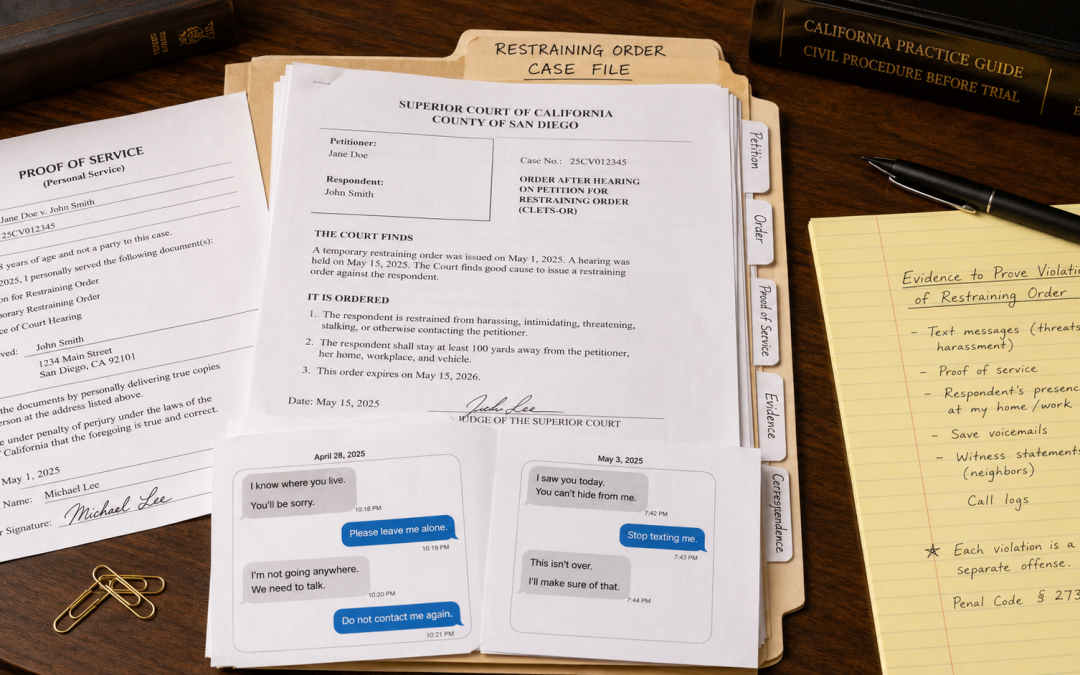
Proving a restraining order violation in California usually requires evidence of three main points: a valid court order existed, the restrained person knew about the order, and the restrained person intentionally violated one of its terms. A violation may involve contact, threats, coming too close to a protected person, entering a protected location, or disobeying a no-contact provision.
California treats restraining order violations seriously because these orders protect personal safety, family stability, and court authority. However, the facts still matter. A strong case often depends on the wording of the order, proof of service, law enforcement reports, messages, photos, video, witness statements, and the timing of the alleged violation.
What Counts as a Restraining Order Violation?
A restraining order violation happens when the restrained person disobeys a term in a valid court order. Depending on the order, the restrained person may need to avoid contact, stay away from a home, workplace, school, vehicle, or family member, surrender firearms, or stop harassing conduct.
California courts explain that enforcing a restraining order often starts with reporting the violation to law enforcement. The protected person should keep a copy of the order available, and the California Courts Self-Help Guide recommends taking phone photos of all pages so proof stays accessible if the order does not appear immediately in CLETS, California’s law enforcement restraining order database. The court guide also explains how to enforce a restraining order after a violation.
Common violations may include:
- Calling, texting, emailing, or messaging through social media
- Asking another person to contact the protected person
- Coming within a prohibited distance
- Showing up at a protected home, workplace, school, or vehicle
- Threatening, stalking, or harassing the protected person
- Refusing to move out when the order requires it
- Possessing firearms when the order prohibits possession
In many cases, the exact wording of the restraining order controls. A message that violates a full no-contact order may not violate a different order that allows peaceful contact about child exchanges.
What Prosecutors Must Prove
Under Penal Code Section 273.6, California makes it a crime to knowingly and intentionally violate certain protective or restraining orders. This law covers several types of orders, including domestic violence protective orders, civil harassment restraining orders, workplace violence orders, elder abuse restraining orders, and other qualifying court orders.
To prove a criminal violation, prosecutors generally must show:
- A valid restraining or protective order existed
- The restrained person knew about the order
- The restrained person had the ability to follow the order
- The restrained person intentionally violated the order
Knowledge often becomes one of the most important issues. Prosecutors may rely on personal service, proof of service, court minutes, a signed order, a prior court appearance, police warnings, or communications showing the restrained person knew about the order.
Evidence That May Help Prove a Violation
Evidence should connect the restrained person to the conduct and show how the conduct violated the order. The most useful evidence often shows date, time, location, identity, and the specific order term at issue.
Helpful evidence may include:
- A copy of the restraining order
- Proof of service
- Police reports or incident numbers
- Text messages, emails, voicemails, or call logs
- Social media messages or screenshots
- Photos or videos
- Doorbell camera footage
- GPS, location, or workplace records
- Witness statements
- Medical records or injury photos, if relevant
Screenshots should show the sender, date, time, and full context whenever possible. In addition, messages should not be edited or cropped in a way that removes important surrounding details. The California Courts Self-Help Guide advises parties preparing for restraining order court to gather evidence such as photos, messages, emails, social media posts, medical records, police reports, and witness statements when those items support the request. The same types of court evidence can also help document later violations.
Why Proof of Service Matters
Proof of service can make or break a restraining order violation case. A restrained person usually must know about the order before prosecutors can prove a knowing violation.
Service often happens when someone legally delivers the order to the restrained person. After service, the server completes a proof of service form and files it with the court. In some situations, actual notice may also matter. For example, California court rules state that when a respondent appears remotely at a hearing and receives actual notice of the order after hearing, no additional proof of service is required for enforcement of the order. The rule appears in California Rules of Court Rule 3.1162.
If law enforcement cannot confirm service or CLETS entry, officers may still warn the restrained person about the order. After that warning, a later violation may become easier to prove because the person received notice.
Penalties for Violating a Restraining Order
A first violation of a restraining order under Penal Code Section 273.6 is usually a misdemeanor. A conviction can carry up to one year in county jail, a fine of up to $1,000, or both.
The penalties can increase when the violation causes physical injury. In that situation, the statute may require at least 30 days in county jail and allow a fine of up to $2,000. Repeat violations, violence, injuries, criminal protective orders, or other aggravating facts can also create more serious exposure.
A restraining order violation may also affect a related family law, custody, divorce, or criminal case. For example, a documented violation can influence future court orders, custody conditions, firearm restrictions, probation terms, or bail conditions.
FAQs About Proving a Restraining Order Violation
Can text messages prove a restraining order violation?
Yes. Text messages can help prove a violation when the order prohibits contact and the messages show the sender, date, time, and content. Screenshots should preserve the full context whenever possible.
Does a protected person need a police report?
A police report is not always required, but it can help document the incident. California courts explain that anyone can report a violation of a restraining order to law enforcement.
Can indirect contact violate a restraining order?
Yes, if the order prohibits indirect contact. A restrained person may violate the order by asking another person to send messages, make threats, or communicate on their behalf.
What if the restrained person says they did not know about the order?
Knowledge is often a key issue. Proof of service, court appearances, signed paperwork, police warnings, or other evidence may show the restrained person knew about the order before the alleged violation.
Legal Help With a Restraining Order Violation
A restraining order violation can affect safety, criminal exposure, custody, housing, immigration concerns, and future court orders. Strong proof usually depends on clear documentation, the exact language of the order, proof of service, and evidence connecting the restrained person to the conduct.
Her Lawyer, A Professional Law Corporation, assists with California restraining order and related criminal defense matters. Contact Her Lawyer to request a confidential consultation and discuss possible next steps.