
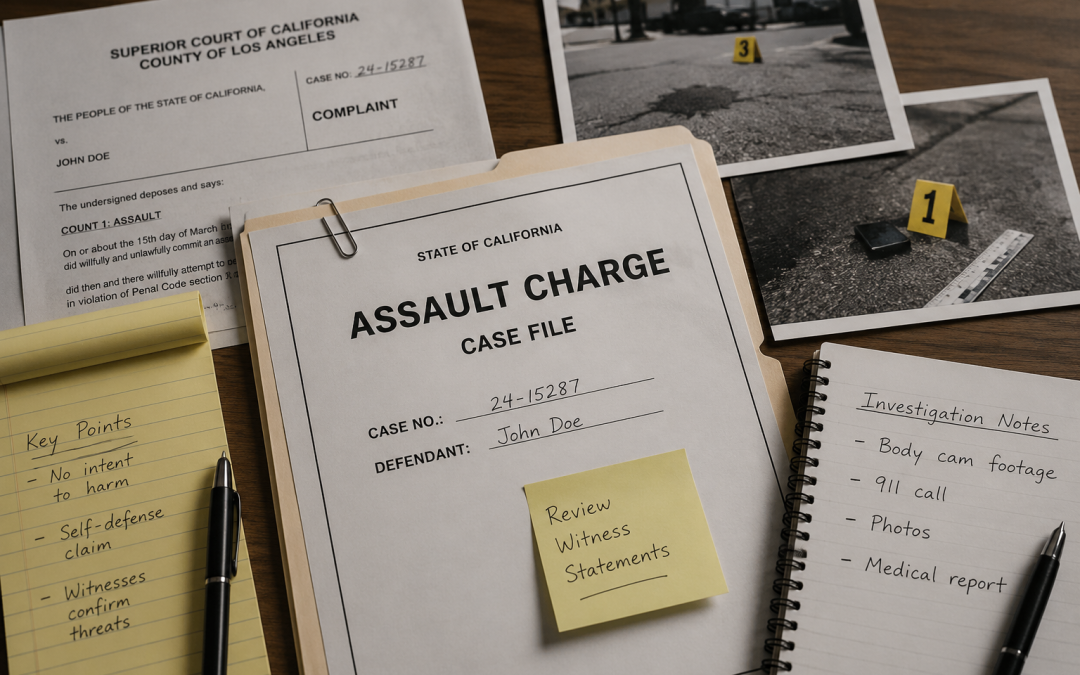
Fighting assault charges in California usually starts with understanding what prosecutors must prove. An assault charge does not always require physical contact. Instead, prosecutors may pursue a case when they believe a person unlawfully attempted to use force and had the present ability to do so.
California treats assault cases seriously because they can affect employment, licensing, immigration status, custody disputes, and future criminal exposure. However, the strength of the case depends on the facts, witness statements, police conduct, available defenses, and the exact Penal Code section charged.
What Is Assault Under California Law?
Under Penal Code Section 240, assault means an unlawful attempt, combined with a present ability, to commit a violent injury against another person. Because assault focuses on an attempted use of force, prosecutors do not need to prove the alleged victim suffered an injury.
For example, a person may face an assault charge after raising a fist, swinging and missing, or making a movement prosecutors believe showed an immediate ability to apply force. Still, words alone usually do not create assault unless the words connect to conduct showing a present ability to use force.
Assault also differs from battery. Battery involves the willful and unlawful use of force or violence on another person. In simple terms, assault can involve an attempted touching, while battery involves an actual unlawful touching.
Simple Assault Penalties in California
Simple assault is usually a misdemeanor. Under Penal Code Section 241, a conviction can carry up to six months in county jail, a fine of up to $1,000, or both.
However, penalties can increase when the alleged victim belongs to a protected category and the accused person knew or reasonably should have known the person’s role. For example, assault against certain peace officers, firefighters, emergency medical technicians, health care workers, process servers, code enforcement officers, or similar protected workers can carry up to one year in county jail and a fine of up to $2,000.
A court may also impose probation, stay-away orders, anger management classes, community service, or restitution. As a result, even a misdemeanor assault case can create consequences beyond jail and fines.
Assault With a Deadly Weapon
Some assault cases involve more serious allegations. Penal Code Section 245 covers assault with a deadly weapon, assault with a firearm, and assault by force likely to produce great bodily injury.
This charge can involve objects beyond knives or firearms. In some cases, prosecutors may argue a vehicle, bottle, tool, or other object became a deadly weapon because of how the person allegedly used it. The statute also covers force likely to cause great bodily injury, even when no traditional weapon appears in the case.
Penalties depend on the alleged weapon, injury risk, and victim category. For instance, assault with a deadly weapon other than a firearm can carry two, three, or four years in state prison, up to one year in county jail, a fine up to $10,000, or both. Assault with certain firearms or assault against a peace officer or firefighter can carry higher prison exposure.
Because Penal Code Section 245 can be charged as a felony in many cases, the defense strategy often begins with a close review of the object, the alleged movement, the distance between the people involved, body camera footage, and whether the facts truly show force likely to cause great bodily injury.
Common Defenses to California Assault Charges
A defense to assault charges depends on the facts. Still, several defenses often appear in California assault cases.
Common defenses may include:
- The person did not have the present ability to use force
- The alleged act was accidental
- The accused person acted in self-defense
- The accused person acted in defense of another
- Witnesses misunderstood or exaggerated the event
- The alleged victim made a false accusation
- The police report left out important context
- The prosecution cannot prove intent or unlawful conduct
Self-defense can play a major role. Under California’s self-defense jury instruction, a person may use reasonable force when the person reasonably believes they face imminent unlawful touching or injury, reasonably believes immediate force is necessary, and uses no more force than reasonably necessary.
In addition, the prosecution must prove the charge beyond a reasonable doubt. If evidence creates reasonable doubt about present ability, intent, self-defense, or witness reliability, the case may become harder for prosecutors to prove.
What Happens After an Assault Arrest?
After an assault arrest, prosecutors decide whether to file charges, reject the case, or request more investigation. If prosecutors file charges, the case usually begins with an arraignment. At that hearing, the court advises the defendant of the charge, addresses release conditions, and takes a plea.
From there, the case may involve discovery, negotiations, motions, witness interviews, and possible trial preparation. Discovery can include police reports, body camera footage, 911 calls, medical records, photographs, text messages, and witness statements.
Sometimes, assault cases resolve through dismissal, reduction, diversion, deferred entry options, or plea negotiations. However, those outcomes depend on the facts, criminal history, alleged injuries, witness cooperation, and local court practices. Her Lawyer’s article on getting a better plea bargain explains how plea discussions can affect a criminal case.
FAQs About Fighting Assault Charges in California
Can a person face assault charges without touching anyone?
Yes. California assault law focuses on an unlawful attempt to use force combined with the present ability to do so. Battery requires actual unlawful force or touching, but assault does not.
Is simple assault a misdemeanor in California?
Usually, yes. Simple assault under Penal Code Section 240 is generally punished under Penal Code Section 241 as a misdemeanor with up to six months in county jail, a fine of up to $1,000, or both.
Can self-defense defeat an assault charge?
Self-defense may apply when a person reasonably believed immediate force was necessary to prevent imminent unlawful touching or injury. However, the force used must remain reasonable under the circumstances.
Can assault with a deadly weapon be a felony?
Yes. Assault with a deadly weapon under Penal Code Section 245 can carry felony penalties, including state prison exposure. The exact penalty depends on the alleged weapon, facts, injuries, and victim category.
Legal Help With California Assault Charges
An assault charge can turn on small factual details: distance, timing, witness credibility, body camera footage, prior threats, injuries, and whether the person had the present ability to use force. For that reason, early review of the evidence can shape the direction of the case.
Her Lawyer, A Professional Law Corporation, assists with California criminal defense matters, including assault, battery, and related charges. Contact Her Lawyer to request a confidential consultation and discuss possible next steps.