
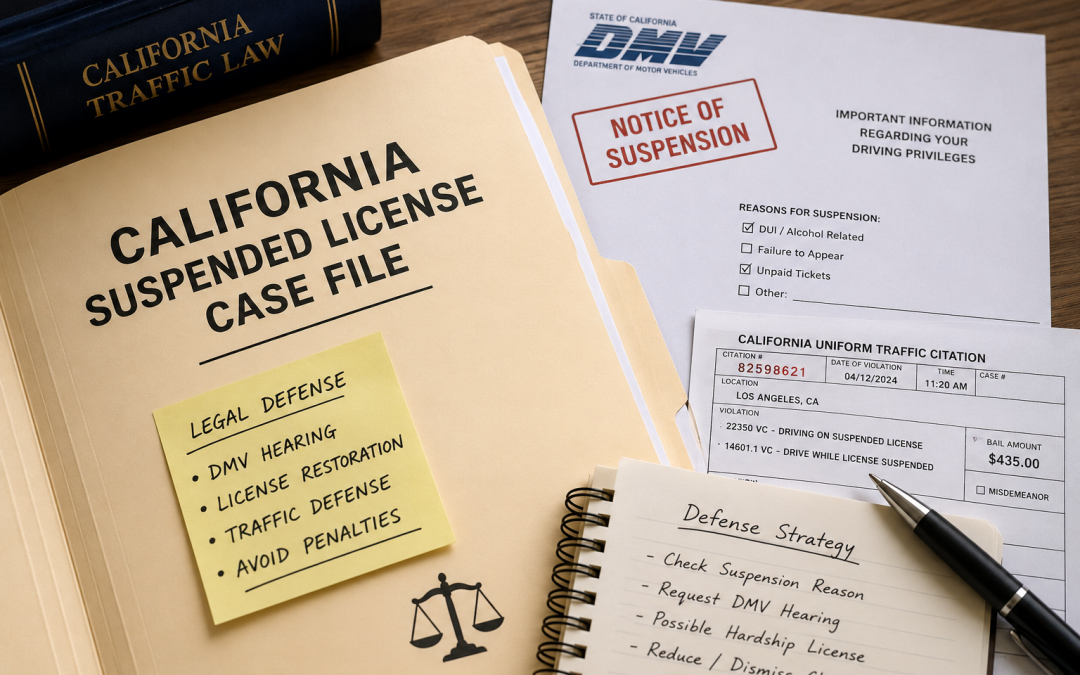
Driving on a suspended license in California can lead to misdemeanor charges, fines, jail time, probation, vehicle impoundment, and a longer license problem. The penalties depend on why the license was suspended and whether the person has prior convictions.
A suspended license case often turns on one key issue: whether the driver knew their license was suspended or revoked.
What Does Driving on a Suspended License Mean?
A suspended license means the DMV or court temporarily removed a person’s driving privilege. A revoked license means the driving privilege was terminated and may require a stronger reinstatement process.
California can suspend or revoke driving privileges for many reasons, including DUI, too many DMV points, failure to maintain insurance, medical issues, reckless driving, unpaid child support, or serious traffic violations.
The California DMV provides information about driver’s license suspensions and how different suspension actions may affect driving privileges.
California Vehicle Code Section 14601.1
Vehicle Code Section 14601.1 applies when a person drives with a suspended or revoked license for reasons not covered by other suspended-license statutes, and the person has knowledge of the suspension or revocation.
A first conviction under this section can lead to county jail, fines, or both. A later conviction within five years can bring higher fines and a longer jail range.
This statute often applies to non-DUI suspensions. However, the exact charge depends on the suspension reason listed in the DMV record.
DUI-Related Suspended License Charges
DUI-related suspensions usually carry more serious penalties.
Vehicle Code Section 14601.2 applies when a person drives with a license suspended or revoked because of certain DUI-related convictions and has knowledge of the suspension or revocation.
A first conviction can carry 10 days to six months in county jail and a fine. A second conviction within five years can carry 30 days to one year in county jail and higher fines.
A DUI-related suspended license case may also create probation problems if the person is still on DUI probation. Her Lawyer’s article on being pulled over for DUI but not charged explains related DUI charging and license issues.
Other Suspended License Statutes
California has several suspended-license statutes. Each one applies to a different type of suspension.
Vehicle Code Section 14601 may apply to suspensions involving reckless driving, negligent driving, or certain serious driving conduct.
Vehicle Code Section 14601.5 may apply when a person drives after an administrative DUI-related suspension, such as an Admin Per Se suspension after a chemical test issue or DUI arrest.
Because the statute matters, the citation number should be reviewed carefully. A charge under Section 14601.2 can carry different consequences than a charge under Section 14601.1.
Knowledge of the Suspension
Prosecutors must usually prove the person knew the license was suspended or revoked. This issue can become one of the most important defenses.
Knowledge may come from:
- A DMV suspension notice mailed to the driver
- A court warning
- A prior DUI or traffic case
- A signed citation
- DMV records
- A prior reinstatement attempt
- Statements made to police
A person may have a defense if they never received notice, believed the license was reinstated, or had a valid reason to think the suspension had ended. However, California law may allow courts to presume knowledge when DMV properly mailed notice to the address on record.
Possible Penalties
Penalties depend on the statute, suspension reason, and prior record. Possible consequences include:
- County jail
- Criminal fines
- Informal probation
- Additional license suspension
- Vehicle impoundment
- DMV points
- Higher insurance costs
- DUI probation violation
- Ignition interlock device issues in some DUI-related cases
The court may also require proof of insurance, payment of fines, or compliance with DMV reinstatement requirements before the person can drive legally again.
Can the Car Be Impounded?
Yes. Police may impound a vehicle after a suspended-license stop in some cases. The length and cost of the impound depend on the statute, local policy, and vehicle ownership.
Impound fees can become expensive quickly. A vehicle owner may need to contact the impound yard, law enforcement agency, or local hearing office to understand release options.
Common Defenses
A suspended-license defense depends on the records and facts. Common defenses may include:
- No knowledge of the suspension
- DMV mailed notice to the wrong address
- The license had already been reinstated
- The driver had a valid restricted license
- The person was not driving
- Police stopped the vehicle unlawfully
- DMV records contain an error
- The charge lists the wrong Vehicle Code section
A restricted license can also create disputes. For example, a person may have permission to drive to work, school, treatment, or an ignition interlock device service appointment. The exact restriction terms matter.
How to Reinstate a Suspended License
Reinstatement depends on the reason for suspension. A driver may need to finish the suspension period, file proof of financial responsibility, complete a DUI program, pay court fines, clear child support issues, install an ignition interlock device, or pay DMV reissue fees.
The DMV’s licensing fees page lists reissue and reinstatement fees. DUI-related reinstatement may also require proof of insurance and a reissue fee.
A driver should not assume the license automatically becomes valid when the suspension period ends. DMV requirements must usually be completed before driving privileges return.
FAQs About Driving on a Suspended License
Is driving on a suspended license a misdemeanor in California?
Often, yes. Many suspended-license charges are misdemeanors. The exact classification depends on the statute, suspension reason, and case history.
Can a person go to jail for driving on a suspended license?
Yes. California suspended-license statutes can carry county jail time, especially when the suspension is DUI-related or the person has prior convictions.
Does the prosecutor need to prove knowledge?
Yes. Suspended-license charges usually require proof that the driver knew about the suspension or revocation. DMV notices and court records often become important evidence.
Can a suspended license charge be dismissed?
Sometimes. A case may be dismissed or reduced if the driver lacked notice, the license was valid, police made an unlawful stop, or DMV records do not support the charge.
Legal Help With a Suspended License Charge
Driving on a suspended license can create criminal, DMV, insurance, and employment consequences. The strongest defense often depends on the suspension reason, DMV notice, license status, and traffic stop.
Her Lawyer’s California criminal defense attorneys assist with suspended-license charges, DUI-related traffic cases, and criminal defense matters. Contact Her Lawyer to discuss a California suspended-license charge.