
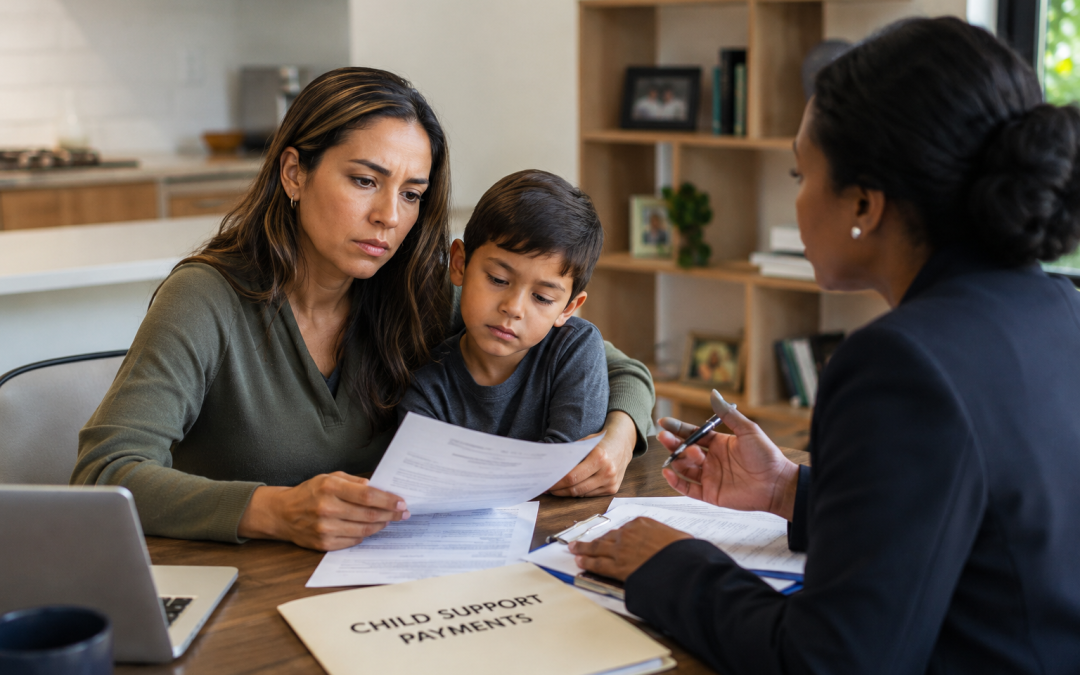
A parent may collect back child support in California when the other parent fails to make payments required by a court order. The unpaid balance is known as child support arrears.
Contempt is one possible enforcement method, but it is not always the first or only step. Wage withholding, bank levies, property liens, tax refund interception, and assistance from a local child support agency may also help recover unpaid support.
Confirm the Child Support Order and Amount Owed
Child support arrears generally arise from an existing court order. Informal promises or private agreements that were never approved by a judge usually cannot be enforced as child support judgments.
A parent seeking enforcement should collect:
- A copy of the current support order
- A payment history from the State Disbursement Unit
- Bank records or receipts showing direct payments
- Records of missed or partial payments
- Prior enforcement documents
Disagreements about the amount owed may require the court or local child support agency to calculate the arrears.
When no support order exists, a parent may ask the court to establish one. California courts may order support retroactive to the filing date of the request in some cases, but unpaid expenses from before that date do not automatically become child support arrears.
Is There a Deadline to Collect Back Child Support?
California does not impose a general three-year deadline for collecting unpaid child support under a valid judgment. Child support judgments remain enforceable until paid in full.
The three-year period applies specifically to contempt proceedings. A contempt action for a missed child support payment generally must begin within three years after that payment became due. Other enforcement methods may remain available after the contempt deadline passes. Her Lawyer’s guide to California’s statute of limitations for back child support explains this distinction.
Ask the Local Child Support Agency for Enforcement
A parent does not necessarily need to begin with a private contempt action. California’s local child support agencies can enforce new and existing orders, track payments, locate a paying parent, and pursue past-due support.
Agency enforcement may include:
- Income withholding
- Bank account levies
- State and federal tax refund interception
- Property liens
- License suspension procedures
- Passport-related enforcement
- Credit reporting
A parent may enroll for services even when the support order originated in a divorce or parentage case. The agency does not represent either parent individually, but it can take enforcement action to collect support.
Use an Income Withholding Order
Income withholding is one of the most common ways to collect back child support in California. An Income Withholding Order directs the paying parent’s employer to deduct current support and an additional amount toward arrears.
When a local child support agency participates in the case, it generally handles service of the withholding order. Once the employer receives the order, the employer has 10 days to begin withholding from the parent’s next paycheck. Payments pass through the California State Disbursement Unit before reaching the person receiving support.
Income withholding can continue until the unpaid balance and accrued interest are satisfied, subject to federal and state limits on paycheck deductions.
File a Contempt Action
When a parent willfully violates a support order, the person owed support may ask the court to find the paying parent in contempt.
California uses an Order to Show Cause and Affidavit for Contempt, Form FL-410, together with supporting forms describing each violation. The supplied Motion for Contempt guidance provides information about the process.
The parent filing the action must generally identify each missed payment and show that:
- A valid support order existed
- The paying parent knew about the order
- The parent had the ability to comply
- The failure to pay was willful
Contempt can carry serious consequences, including fines, community service, and possible jail time. Because contempt proceedings have procedural and constitutional protections, they require careful preparation.
Interest on Unpaid Child Support
California child support arrears generally accrue interest at 10% per year. Interest arises by law on the unpaid judgment balance; a judge does not need to create a separate discretionary interest rate.
Interest can substantially increase the amount owed when payments remain unpaid for several years. A payment history should separate the unpaid principal from accumulated interest so the balance can be calculated correctly.
Other Ways to Enforce Back Child Support
When wage withholding does not collect the full balance, other enforcement options may be available.
A court process or child support agency may collect funds from a bank account, intercept certain tax refunds, or record a lien against real estate. A lien may affect the paying parent’s ability to sell or refinance the property until the debt is addressed.
Past-due support may also lead to administrative consequences involving professional, occupational, recreational, or driver’s licenses. Significant arrears may affect passport issuance or renewal. These measures are enforcement tools rather than separate payments to the parent receiving support.
Collecting Support After a Child Turns 18
A child reaching adulthood does not erase unpaid support that became due while the order remained active. A parent may continue collecting valid arrears and interest after current support ends.
The payment usually belongs to the person or government entity to whom the arrears are owed, not automatically to the adult child. The result may differ when public assistance was involved and part of the debt was assigned to the government.
Her Lawyer’s overview of back child support laws in California provides additional information about unpaid balances and enforcement.
FAQs About Collecting Back Child Support in California
Is contempt required to collect unpaid child support?
No. Contempt is one enforcement option. Income withholding, agency enforcement, bank levies, liens, and tax refund interception may be available without first obtaining a contempt finding.
Can back child support be collected more than three years later?
Yes. California support judgments remain enforceable until paid. The three-year restriction generally concerns the use of contempt for a particular missed payment, not the underlying debt.
Can a parent recover back support without a court order?
A private agreement that never became a court order generally does not create enforceable arrears. A court may award support retroactive to the filing date of a support request, depending on the case.
Does interest automatically accrue on unpaid child support?
California arrears generally accrue interest at 10% annually. The interest becomes part of the amount owed and may continue accumulating until the judgment is paid.
Can a lien be placed on the paying parent’s home?
A child support judgment may support a lien against real property. The lien may need to be properly recorded and can affect a later sale or refinancing.
Speak With a California Child Support Attorney
Collecting unpaid support may require accurate payment records, proper court forms, and the right enforcement procedure. The most appropriate approach depends on the age of the debt, the paying parent’s income and assets, and whether a local child support agency participates in the case.
Her Lawyer, A Professional Law Corporation, is a California law firm founded by David Hakimfar, Esq. The firm’s child support attorneys can evaluate a California support matter. Contact Her Lawyer directly to request a consultation.