
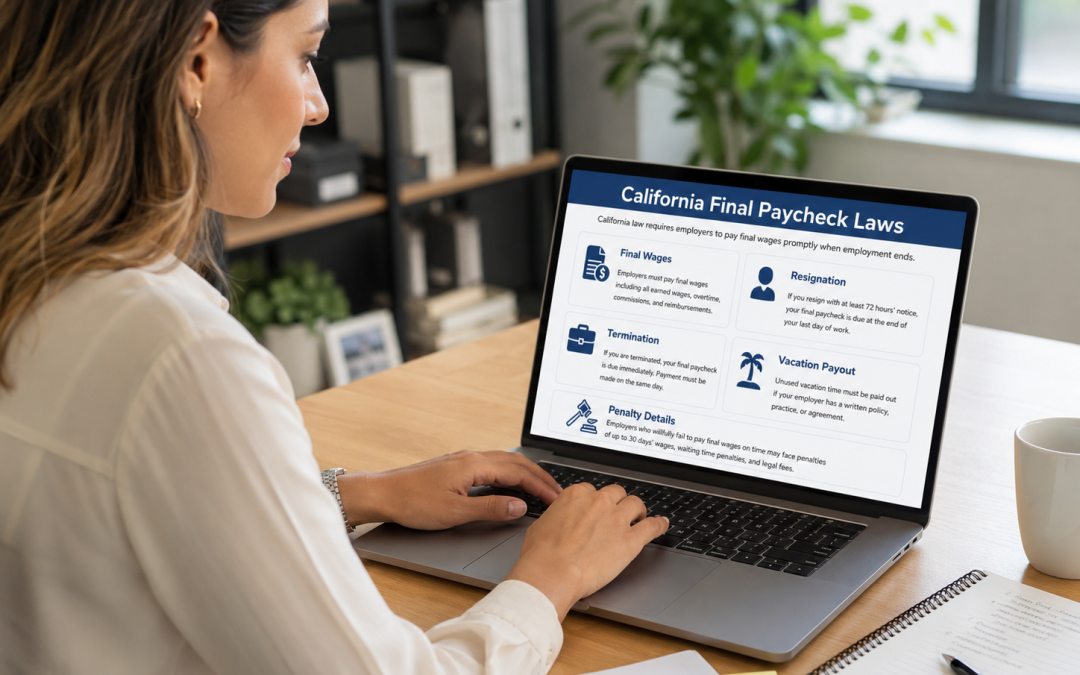
California final paycheck laws require employers to pay final wages quickly when a job ends. The deadline depends on how the employment relationship ended. A fired or laid-off employee usually must receive final wages right away, while an employee who quits may have a different deadline.
Final pay often includes more than regular hourly wages or salary. Depending on the job, an employer may need to include unpaid wages, overtime, earned commissions, accrued vacation, PTO, and other earned compensation. When an employer misses the deadline, California law may add waiting time penalties.
When Final Pay Is Due After Termination
Under Labor Code Section 201, an employer must pay earned and unpaid wages immediately when it discharges an employee. This rule generally applies when an employer fires, lays off, or otherwise ends the employment relationship.
The employer should not wait until the next regular payday. Instead, the employee’s final paycheck should arrive at the time of termination.
The California Labor Commissioner’s guidance on final wages also explains that a discharged employee must receive all wages due, including accrued vacation, immediately at termination.
When Final Pay Is Due After an Employee Quits
A different rule applies when an employee resigns. Under Labor Code Section 202, an employee who quits without at least 72 hours’ notice must generally receive final wages within 72 hours.
When an employee gives at least 72 hours’ notice, the employer must pay final wages at the time of quitting. In that situation, the final paycheck should be ready on the employee’s last day.
An employee who quits without 72 hours’ notice may ask the employer to mail the final paycheck. If the employee makes that request, the mailing date usually counts as the payment date.
What Final Pay Must Include
A final paycheck should include all earned wages through the last day of employment. The exact amount depends on the employee’s pay structure, time records, and written agreements.
Final pay may include:
- Regular wages
- Overtime wages
- Earned commissions
- Earned bonuses, when they qualify as wages
- Piece-rate wages
- Accrued vacation or PTO
- Other earned compensation
Commissions and bonuses can create disputes because payment terms vary. For that reason, commission plans, bonus agreements, wage statements, and payroll records often matter in final paycheck cases.
Vacation and PTO Payout
California treats earned vacation as wages. Under Labor Code Section 227.3, an employer must pay vested vacation when employment ends, unless a valid collective bargaining agreement provides a different rule.
The California Labor Commissioner’s vacation pay guidance explains that earned and unused vacation must be paid at separation. This rule applies whether the employee quit, was fired, or was laid off.
Many employers combine vacation and sick leave into a PTO bank. When PTO functions like earned vacation, the employer generally must pay unused vested PTO at separation. Paid sick leave follows different rules unless the employer’s policy treats it as part of a vested PTO plan.
Waiting Time Penalties for Late Final Pay
California law may add waiting time penalties when an employer willfully fails to pay final wages on time. Under Labor Code Section 203, wages may continue as a penalty from the due date until the employer pays, up to 30 days.
The penalty usually equals the employee’s daily wage rate for each late day. For example, an employee who earns $200 per day may seek $2,000 in waiting time penalties if the employer pays 10 days late.
A good faith dispute may affect penalties. The Labor Commissioner’s waiting time penalty guidance explains that a good faith dispute can exist when an employer has a defense based in law or fact. Still, the employer must pay any wages that are not in dispute.
Can an Employer Deduct Money From a Final Paycheck?
Employers should handle final paycheck deductions carefully. California law limits wage deductions, and an employer generally cannot take money from final wages to recover a separate debt.
For example, an employer should not withhold final pay because an employee failed to return equipment, quit without notice, caused a business loss, or allegedly owes money. The employer may have a separate claim in some situations, but final wage rules still apply.
Standard deductions may still apply. These can include payroll taxes and other deductions allowed by law or valid written authorization.
How to File a Wage Claim for Missing Final Pay
An employee who did not receive final wages on time may file a wage claim with the California Labor Commissioner. The Labor Commissioner provides a process to file a wage claim for unpaid wages, vacation pay, waiting time penalties, and related wage issues.
Useful records may include wage statements, time records, resignation emails, termination notices, commission agreements, PTO records, direct deposit records, and messages with the employer. These documents can help show when employment ended, what wages the employer owed, and when payment arrived.
FAQs About California Final Paycheck Laws
When is a final paycheck due after termination in California?
A fired or laid-off employee generally must receive final wages immediately. The employer usually cannot wait until the next regular payday.
When is a final paycheck due after quitting?
If an employee quits without at least 72 hours’ notice, final wages generally must arrive within 72 hours. If the employee gives at least 72 hours’ notice, final wages must arrive at the time of quitting.
Does California require unused vacation to be paid out?
Yes. California treats earned vacation as wages, so employers generally must pay unused vested vacation when employment ends.
Can an employer withhold final pay until company property comes back?
Usually, no. An employer generally cannot hold final wages as leverage for company property. Any property dispute should move separately from final wage payment.
Legal Help With California Final Paycheck Issues
Final paycheck disputes can involve unpaid wages, late payment penalties, vacation payout, PTO policies, commissions, deductions, and wage claim deadlines. The strongest next step often depends on how employment ended, when payment arrived, what wages were earned, and whether a good faith dispute exists.
Her Lawyer, A Professional Law Corporation, assists with California employment law matters involving final pay, wage disputes, and related workplace issues. Contact Her Lawyer to request a consultation and discuss possible next steps.