
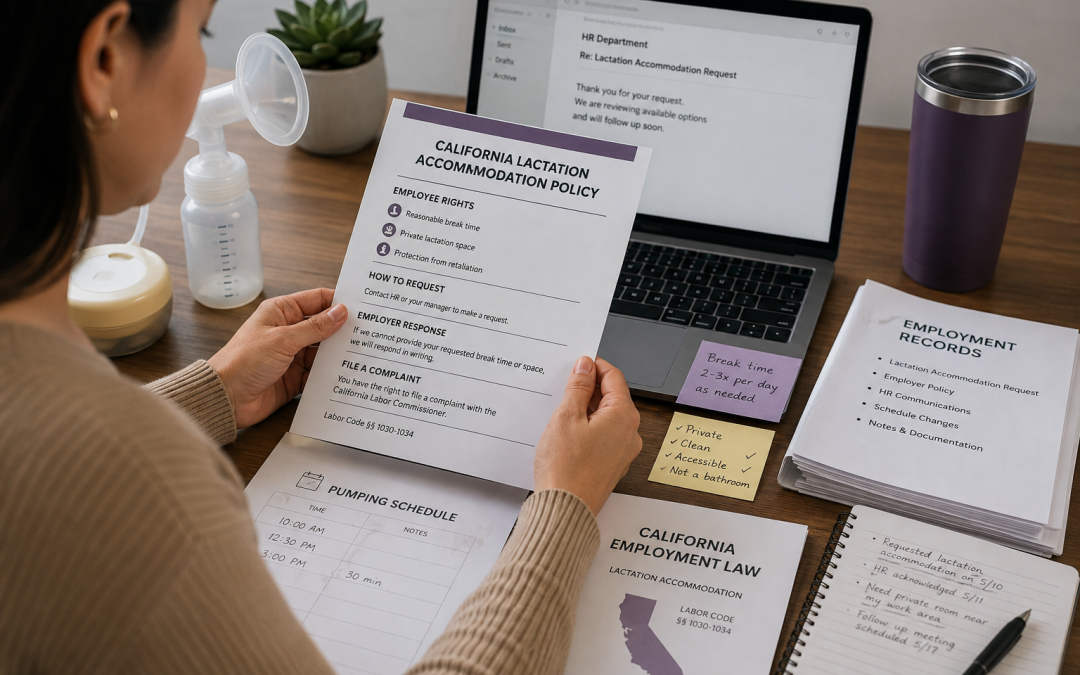
Breastfeeding at work in California can involve lactation breaks, private pumping space, access to basic room features, written employer policies, and protection from retaliation. California law gives employees important rights when they need to express breast milk during the workday.
These rights apply to many workplaces and job types. The exact accommodation may depend on the worksite, schedule, employer size, and job duties, but an employer should not ignore a lactation accommodation request or force an employee to pump in a bathroom.
California Lactation Break Rights
California employers must provide a reasonable amount of break time each time an employee needs to express breast milk for the employee’s infant child. This requirement appears in Labor Code Section 1030.
The break should usually run at the same time as any rest break already provided, when possible. If the employee needs extra time beyond a regular paid rest break, that additional time may be unpaid.
A rigid schedule may not work for every employee. Pumping needs can vary based on milk supply, the child’s feeding schedule, commute time, shift length, and health needs. For that reason, the law focuses on a reasonable amount of break time each time the employee has a need to express milk.
Private Lactation Space Requirements
California law requires more than break time. Employers must also provide a proper lactation room or location.
Under Labor Code Section 1031, the lactation space must not be a bathroom. It must be close to the employee’s work area, shielded from view, and free from intrusion while the employee expresses milk.
The Labor Commissioner explains that the lactation location must be safe, clean, and free from hazardous materials. It must also include a surface for a breast pump and personal items, a place to sit, and access to electricity or another device needed to operate an electric or battery-powered pump.
Can an Employer Use a Temporary Lactation Space?
Yes, in some cases. A lactation space does not always need to be permanent. A temporary space may work if it meets legal requirements while the employee uses it.
For example, a private office, wellness room, conference room, or converted space may work if it is close to the work area, shielded from view, free from intrusion, clean, safe, and not a bathroom.
However, a space usually creates problems if employees can walk in, cameras can view the area, the door cannot lock, hazardous materials are stored there, or the employee must travel far from the work area. A bathroom or toilet stall does not meet the California standard.
Employer Lactation Accommodation Policies
California employers must have a lactation accommodation policy. Under Labor Code Section 1034, the policy must include a statement about an employee’s right to request lactation accommodation, the process for making a request, the employer’s duty to respond if it cannot provide the requested break time or space, and the employee’s right to file a complaint with the Labor Commissioner.
Employers must include this policy in an employee handbook or policy set when one exists. They must also distribute it to new employees and to employees who ask about or request parental leave.
A written policy helps both sides. It can explain where to make the request, who reviews it, what room is available, how scheduling works, and how the employer will prevent interruptions.
Retaliation and Discrimination
California law protects employees who request lactation accommodation, use lactation breaks, or complain about a denial. An employer should not discipline, terminate, reduce hours, demote, harass, or punish an employee for asserting these rights.
The Labor Commissioner may issue a civil citation when an employer violates lactation accommodation rules. The agency explains that the penalty can be $100 for each day an employee is denied reasonable break time or adequate space to express milk. Employees may also file a retaliation claim if they face punishment for asserting or attempting to assert lactation accommodation rights.
Breastfeeding may also connect to sex discrimination protections. The California Civil Rights Department states that California employment law protects workers from illegal discrimination based on sex and gender, including pregnancy, childbirth, breastfeeding, or related medical conditions.
What If the Employer Denies the Request?
If an employer cannot provide break time or a compliant location, California law requires a written response to the employee. A denial should not be vague or dismissive. The employer should explain the issue and, when possible, make reasonable efforts to provide a lawful alternative.
An employee dealing with a denial may want to keep records. Helpful records may include:
- Lactation accommodation request
- Employer’s written response
- HR emails
- Break schedules
- Photos or descriptions of the space
- Employee handbook policy
- Messages about interruptions
- Discipline or schedule changes
- Witness names
- Written timeline
For example, if an employee asks for a private room and the employer offers a restroom, the written request and response may become important evidence.
Small Employers and Undue Hardship
Some smaller employers may raise hardship concerns about the lactation room requirements. California law allows a narrow hardship exception for employers with fewer than 50 employees if a specific requirement would impose an undue hardship in relation to the size, nature, or structure of the employer’s business.
Even then, the employer must make reasonable efforts to provide a private location other than a toilet stall. The California Department of Public Health summarizes this rule in its lactation accommodation guidance.
This exception does not give an employer permission to ignore lactation needs. It only affects certain space requirements when the employer can show undue hardship.
FAQs About Breastfeeding at Work in California
Does California require lactation breaks at work?
Yes. California employers must provide a reasonable amount of break time each time an employee needs to express breast milk for the employee’s infant child.
Can an employer require pumping in a bathroom?
No. California law states that a lactation room or location cannot be a bathroom. The space must be private, close to the work area, shielded from view, and free from intrusion.
Does the employer need a written lactation policy?
Yes. California employers must maintain a lactation accommodation policy with required information about requests, employer responses, and complaint rights.
Can an employee be fired for requesting lactation accommodation?
No. An employer cannot lawfully retaliate against an employee for requesting lactation accommodation, using protected lactation rights, or complaining about a violation.
Legal Help With Breastfeeding at Work Issues
Breastfeeding at work can affect break time, privacy, schedule changes, discrimination, retaliation, medical needs, and return-to-work planning. A strong next step often depends on the request, employer response, lactation space, policy language, timing, and any discipline or retaliation after the request.
Her Lawyer, A Professional Law Corporation, assists with California employment matters involving lactation accommodation, pregnancy-related rights, discrimination, retaliation, protected leave, and workplace rights. Contact Her Lawyer to request a confidential consultation and discuss possible next steps.