
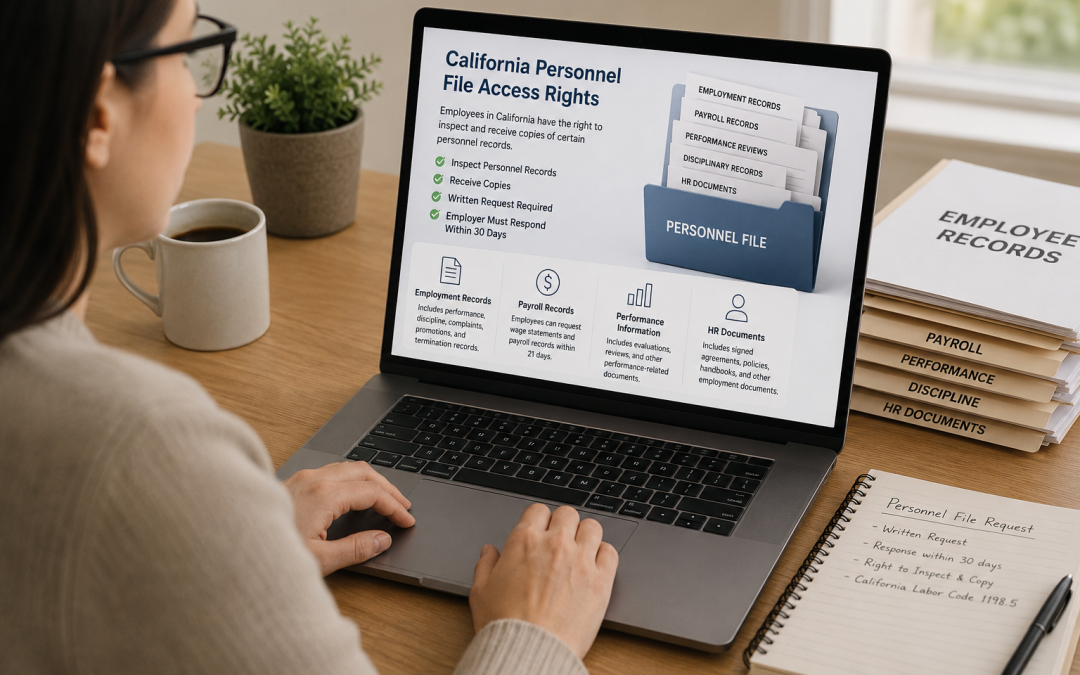
Access to personnel files in California gives current and former employees the right to inspect and receive copies of certain employment records. These records can help employees review performance history, discipline, payroll issues, workplace complaints, termination documents, and other job-related information.
Personnel file access can matter during wage disputes, retaliation claims, discrimination complaints, wrongful termination reviews, unemployment issues, and severance discussions. However, California law treats different records differently, so a personnel file request may not cover every document an employer keeps.
California Personnel File Rights
California Labor Code Section 1198.5 gives current and former employees, or their representatives, the right to inspect and receive a copy of personnel records relating to the employee’s performance or any grievance concerning the employee.
The Labor Commissioner explains that California law gives current and former employees the right to inspect and receive a copy of personnel files and records related to performance or a grievance concerning the employee. The same guidance states that employers must keep personnel records for at least three years after termination. (dir.ca.gov)
A personnel file may include records involving hiring, performance, discipline, promotions, complaints, warnings, evaluations, and termination. The exact contents can depend on the employer’s recordkeeping practices and the type of request.
How to Request a Personnel File
A personnel file request should usually be made in writing. A written request creates a record of the date, recipient, and documents requested.
A request may include:
- Employee name
- Former name, if any
- Job title
- Work location
- Dates of employment
- Contact information
- Request to inspect personnel records
- Request for copies
- Preferred delivery method
- Representative authorization, if applicable
Current employees may request inspection and copies at the place where they report to work or another location agreeable to the employer and requester. Former employees may generally inspect or receive copies at the location where the employer stores the records, unless the parties agree to another location.
Employer Deadline to Provide Records
California employers must make personnel records available for inspection and provide copies within specific timelines. Under Labor Code Section 1198.5, employers must comply with a request as soon as practicable, but no later than 30 calendar days from the date the employer receives the written request.
The employer and requester may agree in writing to extend the deadline by up to five calendar days. If the employer fails to comply, the employee or Labor Commissioner may seek a $750 penalty and other relief under the statute.
Timing matters. A former employee reviewing a termination, wage issue, or discrimination concern should keep a copy of the request and proof of delivery.
Payroll Records and Wage Statements
Payroll records are separate from personnel file records. California Labor Code Section 226 gives current and former employees the right to inspect or copy records relating to wage statements.
Employers must provide access to payroll records within 21 calendar days after a current or former employee makes an oral or written request. If an employer fails to allow inspection or copying within the required time, the employee or Labor Commissioner may recover a $750 penalty. (leginfo.legislature.ca.gov)
Payroll records may help with claims involving unpaid wages, overtime, meal and rest breaks, commissions, deductions, wage statements, final pay, and misclassification.
Signed Employment Documents
California law also gives employees rights to copies of documents they signed. Under Labor Code Section 432, an employer must give an employee or applicant, upon request, a copy of any instrument relating to obtaining or holding employment that the employee or applicant signed.
Signed documents may include:
- Employment agreement
- Arbitration agreement
- Confidentiality agreement
- Commission plan
- Offer letter
- Policy acknowledgment
- Handbook acknowledgment
- Separation agreement
- Non-solicitation or restrictive covenant document
- Training or certification acknowledgment
This right can be important when an employee needs to review arbitration terms, commission rules, confidentiality obligations, severance language, or policy acknowledgments.
What Records May Be Excluded?
A personnel file request does not always require an employer to produce every workplace document. Labor Code Section 1198.5 excludes certain categories from the personnel records covered by that section.
Excluded records may include:
- Records relating to investigation of a possible criminal offense
- Letters of reference
- Ratings, reports, or records obtained before employment
- Records prepared by examination committee members
- Records obtained in connection with a promotional examination
Other laws, privacy rights, attorney-client privilege, trade secrets, or confidential investigation issues may also affect access to some records. Still, an employer should not use broad confidentiality claims to avoid producing records that the law requires.
Requests Through a Representative
An employee may use a representative to request personnel records. The representative may be a lawyer, union representative, or another authorized person.
An employer may require written authorization from the employee before releasing records to the representative. The authorization should identify the representative and confirm permission to inspect or receive the records.
This can matter when a former employee is preparing a wage claim, discrimination complaint, wrongful termination review, or severance analysis.
Why Personnel Files Matter
Personnel file access can help confirm what the employer documented during employment. Records may support or contradict the employer’s explanation for discipline, demotion, denial of promotion, or termination.
Personnel records may help with:
- Wrongful termination review
- Discrimination complaints
- Retaliation claims
- Wage disputes
- Unemployment appeals
- Severance review
- Performance disputes
- Accommodation issues
- Leave disputes
- Workplace grievance records
Her Lawyer’s article on documentation for a wrongful termination case explains how employment records may help organize a disputed firing claim.
What If the Employer Refuses?
If an employer ignores or refuses a lawful request, the employee should keep the request, proof of delivery, employer response, and any follow-up messages. The next step may depend on the record type, deadline, and reason for refusal.
Possible records to preserve include:
- Written personnel file request
- Payroll record request
- Signed document request
- Email delivery confirmation
- Certified mail receipt
- Employer response
- Date records were received
- Notes about missing documents
Labor Code Section 1198.5 allows a current or former employee, or the Labor Commissioner, to recover a $750 penalty from an employer that fails to permit inspection or copying within the required time. The statute also allows a current or former employee to bring an action for injunctive relief to obtain compliance. (leginfo.legislature.ca.gov)
FAQs About Access to Personnel Files in California
Can a former employee request a personnel file in California?
Yes. Current and former employees have the right to inspect and receive copies of personnel records relating to performance or a grievance concerning the employee.
How long does an employer have to provide personnel records?
An employer must provide access or copies as soon as practicable, but no later than 30 calendar days after receiving a written request. The parties may agree in writing to extend the deadline by up to five calendar days.
Can an employee request payroll records separately?
Yes. Payroll records fall under separate rules. Current and former employees may inspect or copy wage statement records, and employers generally must provide access within 21 calendar days after an oral or written request.
Can an employee get copies of documents they signed?
Yes. California law requires employers to provide, upon request, copies of documents relating to obtaining or holding employment that the employee or applicant signed.
Legal Help With Personnel File Access
Personnel file access can affect wage claims, discrimination complaints, retaliation issues, unemployment appeals, severance review, wrongful termination claims, and workplace disputes. A strong next step often depends on the requested records, employer response, deadlines, missing documents, and the reason the records are needed.
Her Lawyer, A Professional Law Corporation, assists with California employment matters involving personnel records, wage disputes, retaliation, discrimination, wrongful termination, leave rights, and workplace protections. Contact Her Lawyer to request a confidential consultation and discuss possible next steps.