
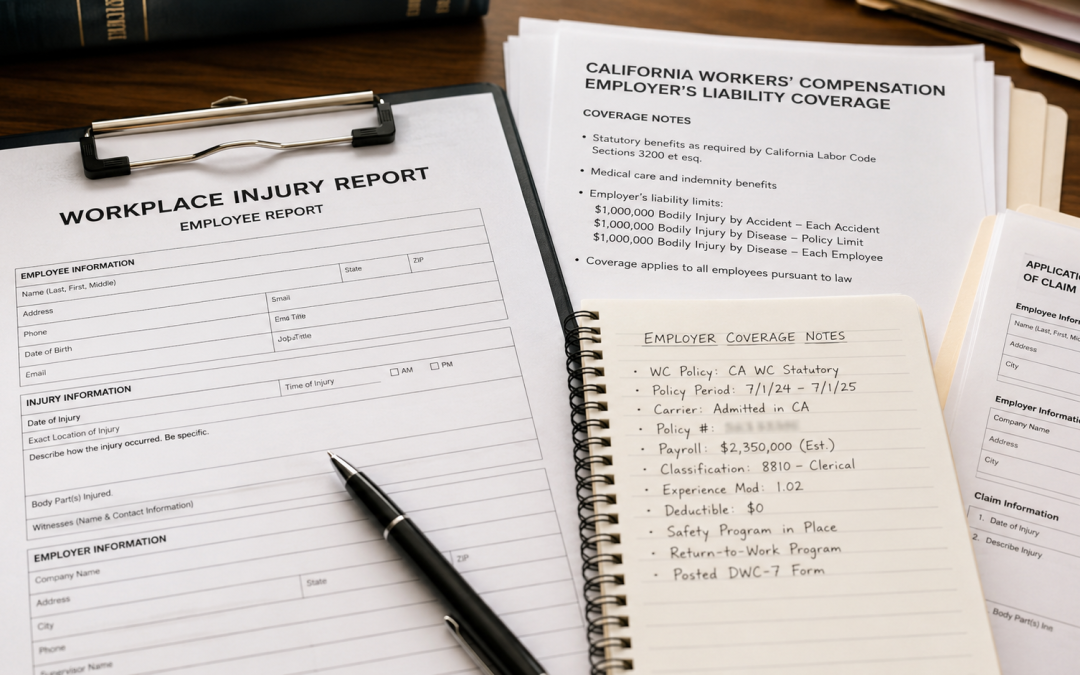
Workers’ compensation is mandatory for most California employers. In general, an employer with one or more employees must provide workers’ compensation benefits through an insurance policy or approved self-insurance.
California workers’ compensation covers employees who suffer work-related injuries or illnesses. The system can pay for medical treatment, temporary disability benefits, permanent disability benefits, supplemental job displacement benefits, and death benefits when the law applies.
Is Workers’ Compensation Required in California?
Yes. Under Labor Code Section 3700, every California employer must secure payment of workers’ compensation. An employer can usually meet this requirement by purchasing workers’ compensation insurance from an authorized insurer or by receiving state approval to self-insure.
The California Division of Workers’ Compensation also explains that all California employers must provide workers’ compensation benefits to employees under Labor Code Section 3700. The state’s employer FAQ confirms this requirement and explains how employers may identify coverage.
This obligation generally applies even when a business has only one employee. It can also apply to part-time, temporary, and seasonal employees. As a result, a small business owner should not assume workers’ compensation coverage is optional.
What Does Workers’ Compensation Cover?
Workers’ compensation applies to many job-related injuries and illnesses. A covered injury may happen in one event, such as a fall, burn, or equipment accident. It may also develop over time, such as a repetitive stress injury or illness caused by workplace exposure.
Covered benefits may include:
- Medical care for the work-related injury or illness
- Temporary disability payments
- Permanent disability payments
- Supplemental job displacement benefits
- Death benefits for qualifying dependents
The California Department of Industrial Relations explains that workers’ compensation provides medical benefits and partial wage replacement when employees recover from work-related injury or illness. The DIR’s small business workers’ compensation guide also explains that self-insurance can satisfy an employer’s coverage obligation when the state approves it.
Are Independent Contractors Covered?
Workers’ compensation usually protects employees, not true independent contractors. However, worker classification can become complicated. An employer cannot avoid workers’ compensation requirements simply by calling a worker an independent contractor.
California uses specific tests to decide whether a worker qualifies as an employee or independent contractor. Misclassification can create serious consequences, especially when a worker suffers an injury and the business lacks coverage.
For that reason, businesses should review worker status carefully. A person labeled as a “1099 contractor” may still qualify as an employee under California law depending on the facts.
What Happens If an Employer Has No Workers’ Compensation Insurance?
An employer that fails to secure workers’ compensation coverage can face serious penalties. The California Division of Workers’ Compensation states that failure to secure workers’ compensation insurance is a misdemeanor punishable by up to one year in county jail, a fine of up to $10,000, or both. The state’s employer FAQ also explains additional penalty exposure when an uninsured employer appears before the Workers’ Compensation Appeals Board.
If an employee gets hurt while the employer lacks required coverage, the employer may become personally responsible for benefits. The employee may also have options through California’s Uninsured Employers Benefits Trust Fund in some cases.
The employer may also lose some legal protections that usually apply in workers’ compensation cases. In certain situations, an injured employee may pursue a civil lawsuit against an uninsured employer in addition to workers’ compensation remedies.
Can an Employee Sue an Employer for a Workplace Injury?
Usually, workers’ compensation serves as the exclusive remedy for workplace injuries. That means an employee often files a workers’ compensation claim instead of suing the employer in civil court.
However, exceptions may apply. An employee may have additional legal options if the employer failed to carry required workers’ compensation insurance, intentionally harmed the employee, fraudulently concealed an injury, or if a third party caused the injury.
For example, a delivery driver injured by another motorist may have a workers’ compensation claim and a third-party personal injury claim. The facts control which claims may apply.
What Should an Injured Employee Do?
After a workplace injury, the employee should report the injury to the employer as soon as possible. The employer should provide a claim form and send the completed form to the insurance company.
The California Division of Workers’ Compensation provides information on filing a claim and explains the basic steps injured workers can take after a workplace injury. Medical records, witness names, photos, incident reports, and work restrictions may also help document the claim.
Important evidence may include:
- Injury report or incident report
- Workers’ compensation claim form
- Medical records
- Work restrictions
- Witness statements
- Photos or video of the accident location
- Employer communications
- Insurance carrier letters
Workers should also keep copies of documents and written communications. Clear records can help if the employer denies the injury, delays paperwork, or disputes whether the injury happened at work.
FAQs About Workers’ Compensation in California
Is workers’ compensation required for one employee in California?
Yes. California generally requires employers with one or more employees to secure workers’ compensation coverage through insurance or approved self-insurance.
Can an employer require an employee to pay for workers’ compensation insurance?
No. Workers’ compensation is an employer obligation. Employers generally cannot require employees to pay for the cost of required coverage.
Does workers’ compensation cover part-time employees?
Yes, workers’ compensation can cover part-time employees if the injury or illness is work-related and the person qualifies as an employee under California law.
What if the employer says the worker is an independent contractor?
The label does not always control. California law looks at the working relationship and classification rules. A misclassified worker may still have workers’ compensation rights.
Legal Help With a California Workers’ Compensation Issue
A workers’ compensation issue can affect medical care, wage replacement, job stability, disability benefits, and legal rights after a workplace injury. The strongest next steps often depend on employment status, coverage, injury records, medical evidence, and whether the employer followed California law.
Her Lawyer, A Professional Law Corporation, assists with California workplace injury and employment-related matters. Contact Her Lawyer to request a confidential consultation and discuss possible next steps.