
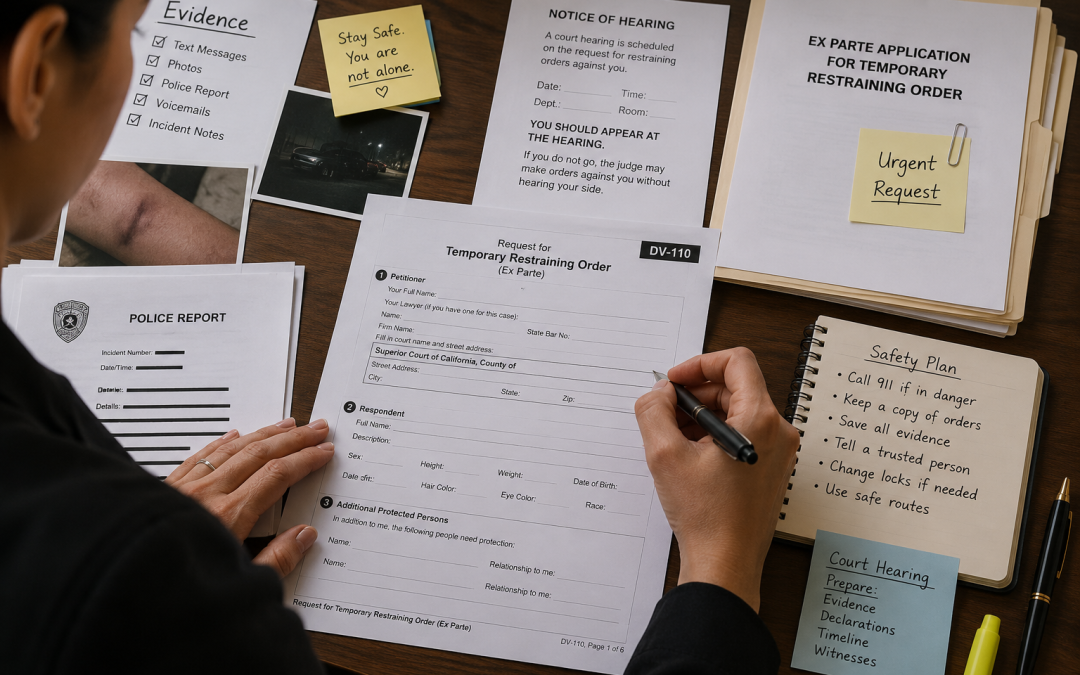
An ex parte motion for a temporary restraining order asks a California court for urgent protection. The court may review the request quickly, often before the other party has a full chance to respond.
A temporary restraining order, or TRO, can arise in several case types. These include domestic violence, civil harassment, elder abuse, workplace violence, school violence, family law, and civil litigation. Each case type has its own forms, deadlines, notice rules, and service requirements.
What Is an Ex Parte Temporary Restraining Order?
A temporary restraining order gives short-term protection until the court holds a hearing. Depending on the case, a TRO may order someone to stop contact, stay away, move out, surrender firearms, preserve property, or stop certain conduct.
California civil cases often rely on Code of Civil Procedure Section 527 for temporary restraining orders. However, that statute does not apply to Family Code orders. Domestic violence and family law matters may follow separate rules.
For civil harassment cases, Code of Civil Procedure Section 527.6 allows a petitioner to request a temporary restraining order. Other statutes may apply to elder abuse, workplace violence, school violence, or other safety concerns.
When Can Someone Request Emergency Relief?
Courts usually reserve ex parte relief for urgent situations. The request should explain why the matter cannot wait for a regular hearing.
Urgency may involve recent violence, threats, stalking, harassment, coercive control, property interference, or workplace danger. In civil litigation, urgency may involve serious harm that could happen before the other side appears.
Evidence matters. A strong request explains what happened, when it happened, who was involved, and why immediate protection is needed. The request should also identify the exact order the court should make.
Notice Rules for Ex Parte Applications
Notice rules depend on the case type. In ordinary civil ex parte applications, California Rules of Court require notice to all parties by 10:00 a.m. the court day before the ex parte appearance, unless exceptional circumstances justify shorter notice. This rule appears in Rule 3.1203.
Family law emergency requests follow a separate rule. Rule 5.151 governs temporary emergency orders in family law cases unless another statute or rule applies. The rule also explains that it does not apply to Domestic Violence Prevention Act requests unless another law says otherwise.
Some restraining order requests may proceed without advance notice. This can happen when notice would create danger, cause more harm, or defeat the purpose of the order. Still, the applicant should use the right forms and explain why notice was not given.
Evidence to Include With the Request
A strong ex parte TRO request should use specific facts. Courts often review emergency requests quickly, so the evidence should make the risk easy to understand.
Helpful evidence may include:
- A detailed declaration
- Recent texts, emails, or voicemails
- Photos of injuries or property damage
- Police reports or incident numbers
- Medical records, if relevant
- Witness declarations
- Social media posts or screenshots
- Call logs
- Prior restraining orders
- Housing, school, or workplace records
- Proof of notice or an explanation for no notice
A declaration should include dates, locations, direct facts, and specific conduct. For example, a statement about five threatening messages sent after an unwanted workplace visit gives the court more useful detail than a general statement about feeling unsafe.
What Happens After the Court Reviews the Request?
After reviewing the request, the court may grant a TRO, deny emergency relief, or schedule a hearing without temporary orders. If the court grants a TRO, the order usually lasts until the hearing date.
At the hearing, both sides can present evidence and respond to the allegations. Then, the judge may grant, change, or deny a longer restraining order.
Service is critical. For many non-family protective orders, California Rule 3.1160 requires personal service of the request, notice of hearing, and any temporary restraining order at least five days before the hearing unless the court shortens time for good cause. In some civil harassment cases, the court may allow another service method if the petitioner cannot complete personal service and the respondent appears to evade service or cannot be located.
If the TRO Is Granted or Denied
If the court grants a TRO, the protected person should read every term carefully. The order may include stay-away terms, no-contact rules, move-out orders, firearm restrictions, custody provisions, or other limits.
The protected person should keep paper and digital copies available. The California Courts Self-Help Guide explains how to enforce a restraining order if a violation occurs. The guide also recommends keeping a copy accessible.
A denial does not always end the case. Sometimes, the court denies emergency relief but still sets a hearing. In that situation, the petitioner may gather more evidence, correct service issues, or prepare to explain why a longer order should issue.
FAQs About Ex Parte TROs in California
How fast can a court issue a temporary restraining order?
Timing depends on the court, case type, forms, and urgency. Some emergency requests receive same-day or next-court-day review.
Does the other person get notice before an ex parte TRO?
Sometimes. Ordinary civil ex parte applications usually require advance notice by 10:00 a.m. the court day before the appearance. Some restraining order procedures allow limited or no advance notice when safety requires it.
What happens if a TRO is granted?
The temporary order usually lasts until the hearing date. The respondent must receive proper service, and the court later decides whether to issue a longer restraining order.
Can a denied TRO request still lead to a hearing?
Yes. A court may deny emergency relief but still schedule a hearing after notice and service.
Legal Help With an Ex Parte TRO Request
An ex parte motion for a temporary restraining order can involve safety, notice, service, evidence, court forms, and strict deadlines. A strong request usually depends on the type of restraining order, urgency, facts, documents, and notice issues.
Her Lawyer, A Professional Law Corporation, assists with California restraining order and related family law matters. Contact Her Lawyer to request a confidential consultation and discuss possible next steps.