
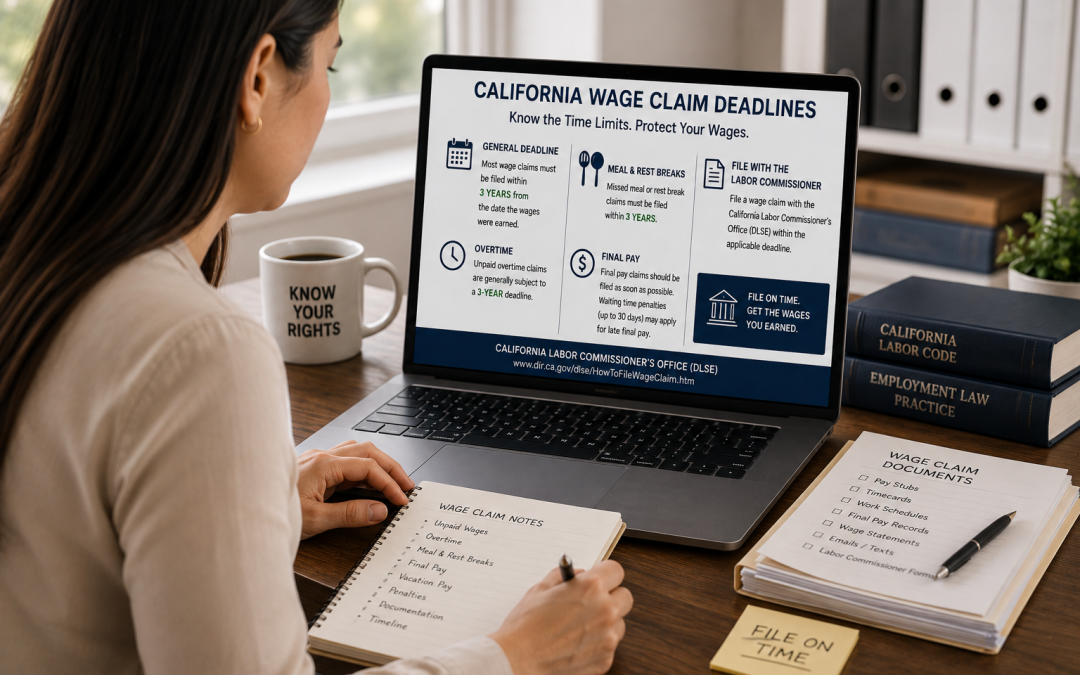
The California wage claim statute of limitations depends on the type of unpaid wage issue, the filing forum, and the legal claim involved. Common wage claims may involve unpaid minimum wage, overtime, meal and rest break premiums, illegal deductions, unpaid reimbursements, late final pay, or unpaid vacation.
California workers can often file wage claims with the Labor Commissioner’s Office, also called DLSE. The California Labor Commissioner explains that workers may file wage claims when employers do not pay wages or benefits owed.
General Deadline for California Wage Claims
Many California wage claims must be filed within three years. The Labor Commissioner’s wage claim guidance lists a three-year deadline for violations involving minimum wage, overtime, unpaid meal and rest breaks, sick leave, illegal deductions, and unpaid reimbursements.
This three-year period often matters for claims involving:
- Unpaid minimum wage
- Unpaid overtime
- Meal break premiums
- Rest break premiums
- Illegal payroll deductions
- Unpaid reimbursements
- Paid sick leave issues
However, wage deadlines can vary depending on the claim. A worker should not assume every wage issue has the same filing period.
Unpaid Minimum Wage and Overtime
Unpaid minimum wage and overtime claims commonly fall within the three-year wage claim deadline listed by the Labor Commissioner. California Labor Code Section 1194 allows employees who receive less than the legal minimum wage or overtime compensation to recover unpaid amounts in a civil action.
California Labor Code Section 510 sets overtime rules for many nonexempt employees. Overtime may apply after more than eight hours in a workday, more than 40 hours in a workweek, or during certain seventh-day work.
Helpful records may include timecards, schedules, pay stubs, wage statements, and messages about hours worked.
Meal and Rest Break Claims
Meal and rest break claims may involve missed, late, short, or interrupted breaks. The Labor Commissioner includes unpaid meal and rest break issues in its three-year wage claim deadline guidance.
Break claims often require detailed time records. For example, an employee may need records showing when shifts started, when meal periods began, whether breaks lasted long enough, and whether work interrupted the break.
Useful records may include:
- Timecards
- Meal period records
- Work schedules
- Payroll summaries
- Supervisor messages
- Written break policies
- Notes about missed breaks
Final Pay and Waiting Time Penalties
Final pay claims may arise when an employer fails to pay all wages due after termination or resignation. The Labor Commissioner’s waiting time penalty guidance explains that an employee may file a wage claim when final wages remain unpaid.
Final pay may include unpaid regular wages, overtime, earned commissions, and vested vacation. If an employer willfully fails to pay final wages on time, California Labor Code Section 203 may allow waiting time penalties up to 30 days.
Because final pay claims can involve both unpaid wages and penalties, a former employee should save final pay stubs, termination documents, resignation notices, vacation balances, and payroll messages.
Wage Statement Claims
Wage statement issues may involve missing or inaccurate information on pay stubs. California Labor Code Section 226 requires employers to provide itemized wage statements with specific information.
Wage statement claims may involve:
- Missing hourly rates
- Missing total hours worked
- Incorrect employer name or address
- Missing pay period dates
- Incorrect deductions
- Missing piece-rate information
- Inaccurate paid sick leave balance, depending on the issue
Deadlines for wage statement penalties can differ from unpaid wage deadlines, so the exact claim should be reviewed separately.
Written Contract or Policy Issues
Some wage disputes involve a written agreement, commission plan, bonus plan, vacation policy, or employment contract. California wage claims may overlap with contract claims when an employer fails to pay compensation promised in writing.
For example, a commission plan may promise payment after certain sales close. If the employer refuses to pay earned commissions, the worker may have wage and contract issues.
Helpful records may include signed agreements, commission plans, bonus policies, offer letters, emails, pay stubs, and sales records.
Filing With the Labor Commissioner
A worker may file a wage claim with the Labor Commissioner by email, mail, or in person. The DLSE filing page provides forms, instructions, and claim categories.
After filing, the Labor Commissioner may review the claim, request documents, hold a settlement conference, schedule a hearing, or issue an order, decision, or award.
A worker should keep copies of:
- Wage claim form
- Supporting documents
- DLSE notices
- Employer responses
- Settlement conference notices
- Hearing documents
- Final order or award
FAQs About California Wage Claim Deadlines
How long does an employee have to file a wage claim in California?
Many California wage claims must be filed within three years, including claims involving minimum wage, overtime, unpaid meal and rest breaks, sick leave, illegal deductions, and unpaid reimbursements.
Can a former employee file a wage claim after termination?
Yes. A former employee may file a wage claim for unpaid wages, overtime, final pay, unpaid vacation, commissions, or other compensation owed.
Do final pay claims have penalties?
Sometimes. If an employer willfully fails to pay final wages on time, waiting time penalties may apply under California Labor Code Section 203.
What records help with a wage claim deadline issue?
Helpful records include pay stubs, timecards, schedules, final paycheck records, wage statements, commission plans, employer policies, and messages about unpaid wages.
Legal Help With California Wage Claim Deadlines
California wage claim deadlines can affect unpaid wages, overtime, meal and rest break premiums, final pay, wage statements, commissions, vacation pay, and penalties. The best next step often depends on the claim type, work dates, pay records, employer policy, and filing deadline.
Her Lawyer, A Professional Law Corporation, assists with California employment matters involving wage claims, unpaid wages, overtime, final pay, retaliation, wrongful termination, and workplace rights. Contact Her Lawyer to request a confidential consultation and discuss possible next steps.